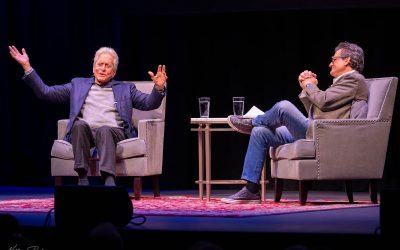
The authors offered readings from their work and answered student questions
November 2026 – Drew University’s Writers@Drew series hosted Isabella DeSendi and Tomás Q. Morín for readings and Q&A with students.
DeSendi, a Latina poet and educator, read from her debut poetry collection Someone Else’s Hunger, which received the gold medal from the 2025 North American Book Awards.
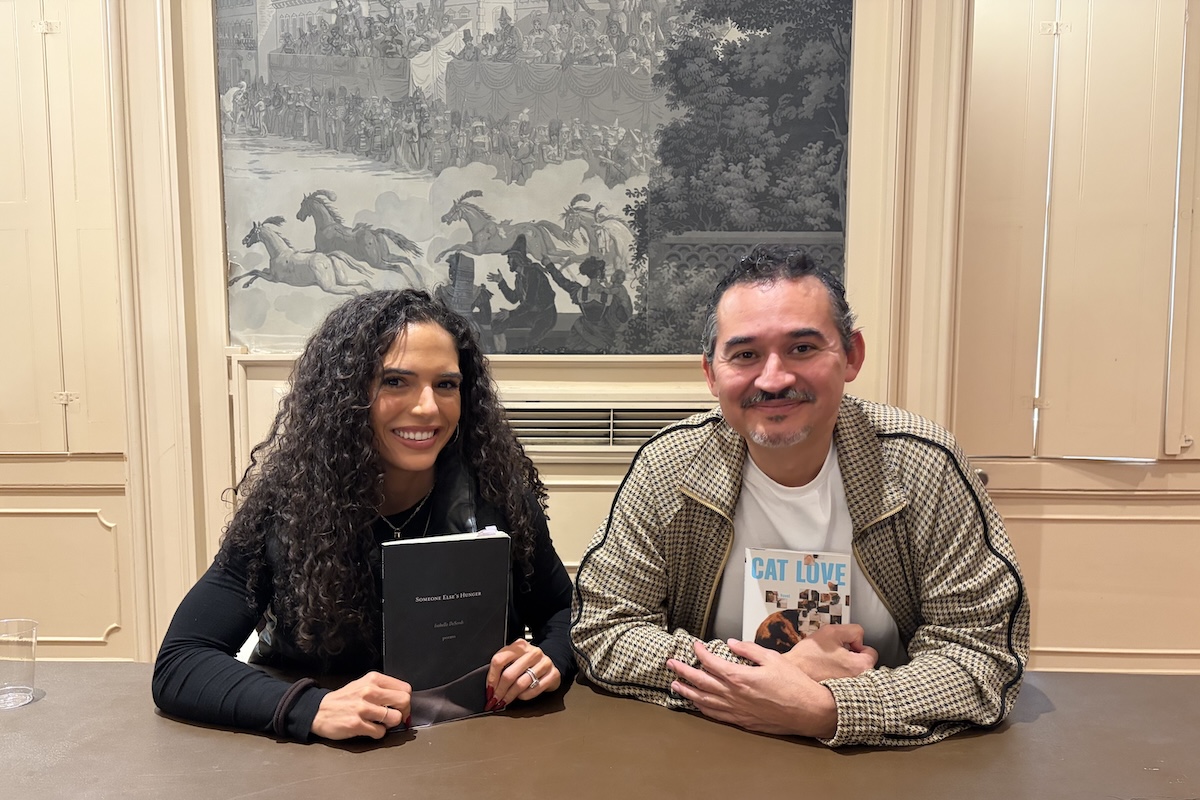
Morín, an author and fellow of the Guggenheim Foundation and the National Endowment of the Arts, offered readings from his novel Cat Love and his forthcoming poetry collection My Favorite Things.
“I mainly took away how one’s writing can evolve in meaning over time, even though the words are the same,” said Clarisse Garcia C’28.
DeSendi introduced her poems with context in this vein, explaining how she wrote them through the lens of sensuality and hunger she felt after being sexually assaulted, but in the midst of her mother’s cancer radiation treatments, they now read to her as if they were created for her mother.
Morín touched on the subject as well, noting how circumstances change and, with that, so too does the writing process. He mentioned how his writing practice has evolved from being a young writer, to an advanced writer, and now as a father, preferring to write at different times of day and night at each stage.
“We are always evolving and our writing and understanding reflects that,” said Garcia. “It’s amazing how our current experiences impact our understanding of what we wrote in the past when our lives were so different.”
The authors were also asked about their relationship to space—physical space and outer space, which both of their writing explores.
DeSendi offered a touching answer, saying she felt she has existed in many bodies throughout her life due to trauma responses and environmental issues, and how her poetry reflects her state of well-being. Morín in turn talked about his OCD and how easily he gets overstimulated. He finds the silence and stillness in outer space to be an imaginative treasure.
DeSendi asked Morín if he always had the ability to “play” in his work, or if he started doing so as a way to stay engaged. He noted “play” comes to him naturally.
“The topic of playing with our words was interesting,” said Garcia. “Morín said that if an author isn’t enjoying the process then readers won’t enjoy it either and I think this is something that a lot of writers need to learn. When we grow up we are taught many rules about writing—where commas go, how to start a sentence, how to insert quotations, etc.—but I think that this almost traumatizes a lot of young writers and forces them to fit in a box that restricts our creativity. I think all writers should experiment with their work so they can understand what it means to love writing.”
For students like Garcia, hearing from published writers offered unique insights into the field.
“It made me realize how possible my dreams are,” she said. “When I hear about bestselling authors and how many books they published, it makes my dreams seem scary and daunting—like, who am I to become a published author or help a person publish their work? But after seeing and hearing how close my dreams are, it reassures me that I can do what I love and be successful at it.”
The free event was co-sponsored by The Casement Fund and Drew University English Department.