Educating New Jersey religious leaders on the interconnectedness of creation and justice
December 2025 – The New Jersey Coalition of Religious Leaders gathered at Drew Theological School for its fall meeting, welcoming John Fletcher Hurst Professor of Ecology, Religion, and Society Laurel Kearns as the keynote speaker.
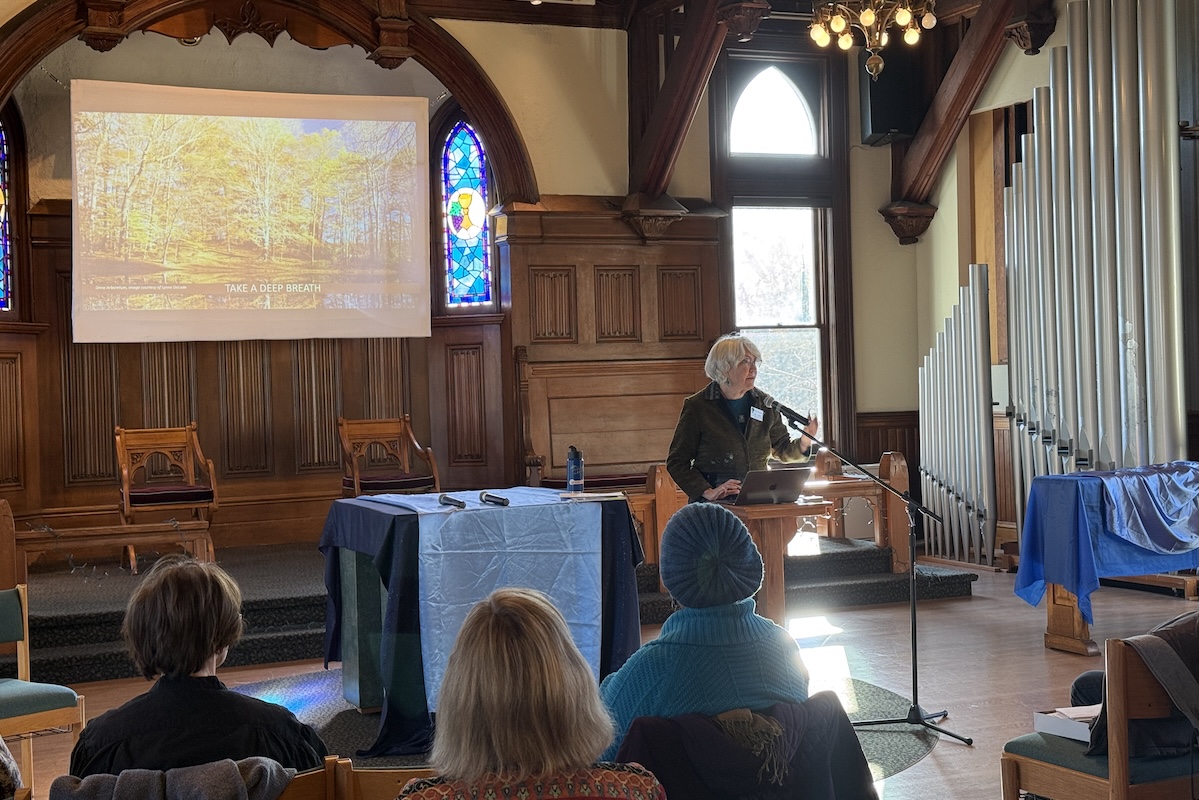
The event opened with a greeting from Associate Dean for Academic Affairs Robert Seesengood, who emphasized the alignment between Drew’s mission and the Coalition’s work.
“We share a vision, we share a vocation, and we share hope for the state of New Jersey and its citizens,” said Seesengood. “The advancement of values in your work resonates with what we try to do with our students.”
Kearns’ talk was grounded in the interconnectedness of spirituality, creation, and justice. She began by discussing the sacred meaning of breath across religious traditions, recognizing the religiously diverse audience.
“We breathe in what the trees breathe out, and the trees breathe in what we breathe out,” she said.
Kearns walked participants through scriptural foundations that frame breath, air, and creation as sacred gifts shared by all living beings. She emphasized that religious traditions call humanity not to dominate creation but to recognize a shared dependence on air, water, and soil as the foundations of life.
“If the atmosphere is infused with the sacred and we are poisoning it, then those who are poisoned by breathing it are also sinned against,” said Kearns.
Turning to New Jersey, Kearns highlighted the disproportionate impact of air pollution on urban communities. In Newark, New Jersey, one in four children suffers from asthma, sharing a story of a young girl whose daily walk through truck-filled streets worsens her asthma and disrupts her school day.
Kearns connected environmental harm with structural inequities, citing theologian James Cone, “The same logic that devalues certain human lives also enables the exploitation of animals and the natural world.”
Eco-justice, she explained, quoting Pope Francis, requires addressing both the “cry of the earth and the cry of the poor.”
She concluded by offering reframed language that can open conversations across political and theological divides. “If talking about climate change feels too political, talk about the right to clean air,” she offered.
”Every child deserves the promise and holy covenant of clean air and a healthy climate,” she said, quoting a key evangelical environmental leader.
Following the presentation, a panel discussion dove deeper into issues before the state legislature and the impact on the religious leaders’ respective communities.