Historic volumes feature signatures of John Wesley (1703-1791) and Sir Robert Cotton (1550-1631)
December 2025 – Sometimes the greatest adventures happen not in far-off places, but right here on our own shelves.
Recently, Drew University’s Manager of Special Collections, Candace Reilly, made two noteworthy identifications within the Special Collections stacks.
Enlarge
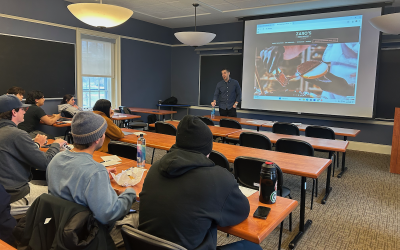
In alignment with broader efforts across archives and research libraries, Drew University Special Collections has been engaged in a systematic review of its holdings to enhance cataloging accuracy and to improve the accessibility of catalog records and finding aids for researchers.
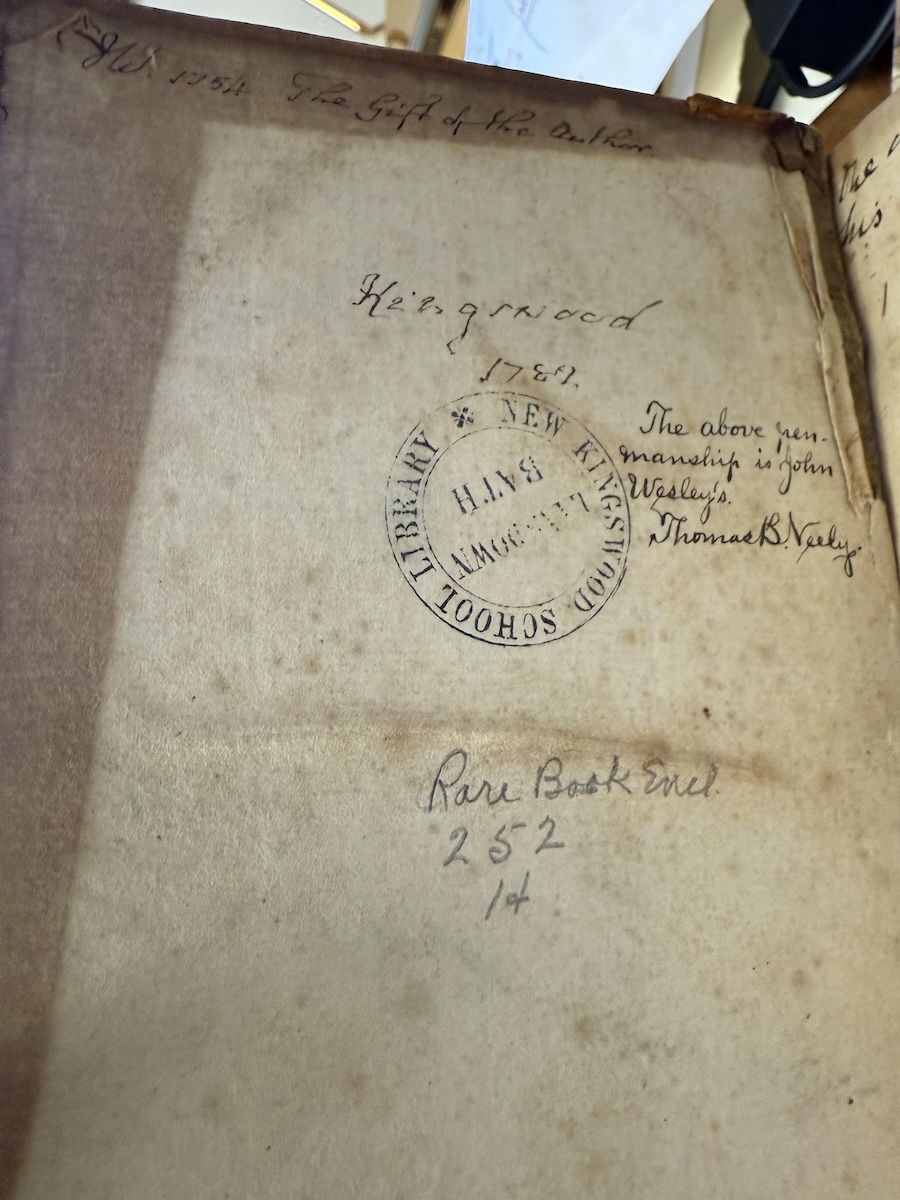
During a routine examination of materials, Reilly encountered a seemingly ordinary copy of Sermons on Various Subjects. However this particular copy bore the signature of John Wesley, a principal founder of Methodism.
On the upper left corner of the endsheet, Wesley inscribed: “J.W. 1754 the gift of the author.” Additional provenance evidence includes a library stamp from the Kingswood School—an institution founded by Wesley—and an inscription recording the book’s later presentation by the school’s governor to Thomas Neeley in 1894.
To confirm the authenticity of Wesley’s signature, Reilly and Alex Parrish, curator of the Methodist Library, consulted scholars Dr. Randy L. Maddox and Dr. Geordan Hammond, and compared the inscription with examples from Drew University’s extensive holdings of Wesley manuscripts.
Enlarge

In that same week, Reilly located another book containing a similarly striking feature of provenance. This time, it was a large, leather-bound book she had not previously studied, a 1608 edition of Philostrati Lemnii opera.
At first glance, the book appeared unexceptional. But a signature on the title page transformed it into a significant artifact. The inscription, “Ro: Cotton,” accompanied by a price notation, immediately suggested to Reilly—drawing on her expertise in book history and provenance—that the volume had once belonged to Sir Robert Cotton, the eminent antiquary.
Cotton’s collection of manuscripts was one of the foundational deposits of the British Library including the Lindisfarne Gospels. Much is known about Cotton’s manuscript collection, while his printed books library had been dispersed and remains largely a mystery. Reilly contacted several institutions known to hold books bearing Cotton’s authenticated signatures, including the Folger Shakespeare Library and the Bodleian Libraries, and identified close parallels between their examples and the signature in Drew’s volume.
“Special collections libraries are marvelous places for research and discovery,” said Reilly. “These two examples underscore the remarkable materials still concealed within our collections, as well as collections around the world, and the critical role that professional expertise and comprehensive resources play in uncovering them.”
Finds such as these—volumes previously owned by John Wesley and Robert Cotton—join a long lineage of rediscoveries made in libraries, archives, and museums. More recent examples include the earliest known draft of the King James Bible (identified in 2015), a lost work by Edith Wharton (found in 2019), and a copy of the Officium beatae Mariae virginis (rediscovered in 2025). Such revelations remind us that even in well-studied collections, significant cultural and historical artifacts may still lie hidden in plain sight.