Showcasing student and alum research and projects
February 2026 — Drew University’s Caspersen School of Graduate Studies hosted its Medical & Health Humanities Spring Colloquium, a one-day event celebrating the scholarship and research of current students and recent alums. The gathering fostered open and candid dialogue, showcasing the breadth of work emerging from the program and the diverse ways Medical & Health Humanities scholars engage questions at the intersection of health, medicine, culture, and care.
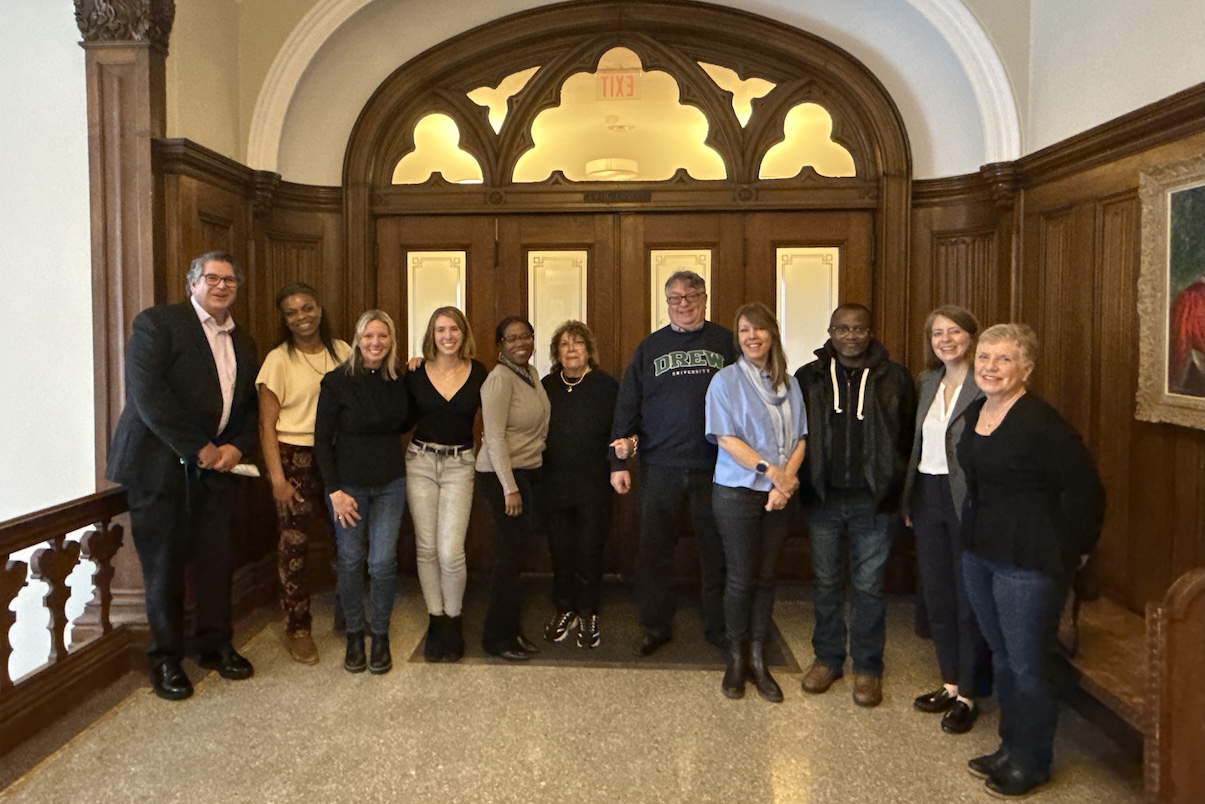
“We chose the title Living Between the Lines: On Involved Knowing in the Health & Medical Humanities because the contributions beautifully demonstrate what ‘involved knowing,’ central to the humanities, means in practice, each in its own distinctive way,” said Program Director Merel Visse. “We all know what it means to live life in the middle of demanding degree work, and that the two somewhat entwine, sometimes more than at other times. This colloquium is about presence and shared inquiry.”
The event featured contributions by doctoral candidates Cynthia Orsini C’00, Melissa Nolan C’88, Taína Thomas, and Ravindra Waykar; Drew Theological School PhD candidate Damien Domenack; Dual-Degree student Maddie Krzanowski C’27, G’28; and recent alums Ian Brown G’26 and Laura Mccullough-Thoms G’26.
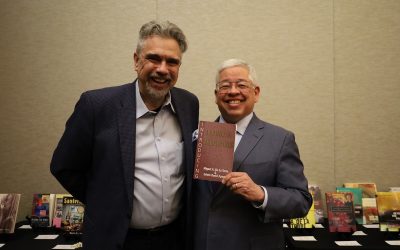
Brown shared highlights from his dissertation research, From Struggle to Belonging, weaving his personal narrative with scholarship to explore how resilience, forgiveness, love, and belonging shape authentic leadership in healthcare. He argues that lived experiences of displacement, homelessness, sexuality, and mentorship are not separate from leadership formation, but foundational to it.
Drawing on his journey from migration and hardship to executive leadership at Duke Health, he positions narrative as both rigorous methodology and ethical tool. His work reframes belonging as an organizational and moral outcome, asserting that resilience strengthens ethical clarity, forgiveness fosters trust, and authenticity creates cultures where individuals can bring their whole selves to work. Leadership is parallel with lived experience and reflective storytelling can transform both leaders and the systems they serve.
Domenack, founding member of the Audre Lorde Project’s Trans Justice initiative, shared his dissertation work on Coalitional Care in Black and Brown Queer and Trans Communities, where he draws on his experience as a longtime trans organizer to develop the concept of coalitional care, examining how community-generated practices of support reshape traditional understandings of public health and faith-based care.
Centering Black and Latina queer and trans House and Ballroom Culture, Domenack argues that these networks function as alternative infrastructures of care by offering mentorship, material support, spiritual grounding, and HIV prevention through embodied practices like performance and ritual.
Krzanowski presented a powerful video interview that chronicled her family’s journey through her mother’s devastating diagnosis. Through expert and caring medical intervention, faith, hope, and gratitude, her mother is now a six-year survivor of glioblastoma, an aggressive stage 4 brain cancer. Krzanowski’s parents, joined by Lily the Sheepdog to provide support, were present to answer questions and elaborate on their journey of healing as a family. “This story typifies the support behind the patient and who you trust with your life,” said Gaetana Kopchinsky C’06, G’08,’11, Affiliate Professor of Medical & Health Humanities.
Mccullough-Thoms shared an excerpt from a longer lecture on conflict transformation titled Age of Anxiety. She reframed conflict not as something to be avoided or solved, but as necessary heat that can spark growth and change. Drawing on neuroscience and threat response theory, she explored how dysregulation, fear, and suppressed conflict can lead to rage and dehumanization, and argued for the importance of self-regulation, co-regulation, and emotional literacy as foundations for both individual and collective transformation.
Orsini shared insights from her dissertation-in-progress, Questioning the Successful Aging Paradigm, which explores how older adults find meaning and well-being in their residential spaces amid changing care needs. Drawing on her background in social work and gerontology, she conducted a multiple case study with eight participants—half aging in place and half recently relocated to senior congregate housing—using in-depth interviews to examine how care needs, socialization, and environment shape their experiences. Orsini highlighted the emotional complexity behind care decisions, the nuanced meanings attached to home, and the distinction between logistical support and lived experience. “I want to give justice to my participants,” she said of her research participants. “I want their stories to be more than data, I want their stories to grow.”
Thomas presented Radical Possibilities, dissertation work that crosses disciplines and areas, exploring the difference between conventional health narratives (clinical, often reductive) and healing narratives (holistic, faith-based, culturally grounded). She wondered what it means to be radical, bridging various fields, creating an entirely new cultural-methodological space for inquiry into (self-)care. “We are the data,” she said. “We word our world.”
Waykar presented Rethinking Clinical Trials: Insights from the Humanities, sharing concerns about safety and well-being of clinical research subjects. With a pharmacist’s background, he examined the historical and ethical evolution of human subjects research, tracing how atrocities during WWII—and the Nuremberg Code that followed—gave rise to modern informed consent. His humanities-informed lens asked how patient rights can be better safeguarded today. Elizabeth Bertolini G’14, a Drew alum and coordinator of Drew’s Morristown Medical & Health Humanities Hospital Certificate, invited him to share his work with the medical residents.
Nolan presented her dissertation research Reconceptualization of the Aging Self–Narrative Insights. Using interpretive phenomenological analysis, she studies the lived experiences of intimacy and sexuality in older adults. She shared a vivid narrative vignette about an 81-year-old who embodies defiant aging, challenging social taboos around older adults’ sexuality and intimacy. This narrative evoked a resonant space, making the participants live an “involved knowing” in real time.
Fostering health and medicine as relational, ethical practices and institutions is the mission of the low-residency and interdisciplinary Medical & Health Humanities program at Drew University. Offering a master’s, doctorate, and several certificates, these degrees meet the growing need for advanced training in health humanities, care ethics, health policy, contemplative care, and narrative medicine.