Written by Lexi Goldspinner C’28, an English, art, and philosophy triple major
March 2026 – Drew University’s English Department welcomed the new year with a meaningful Writers@Drew Diasporic Literature Panel featuring authors Moriel Rothman-Zecher and Javier Fuentes.
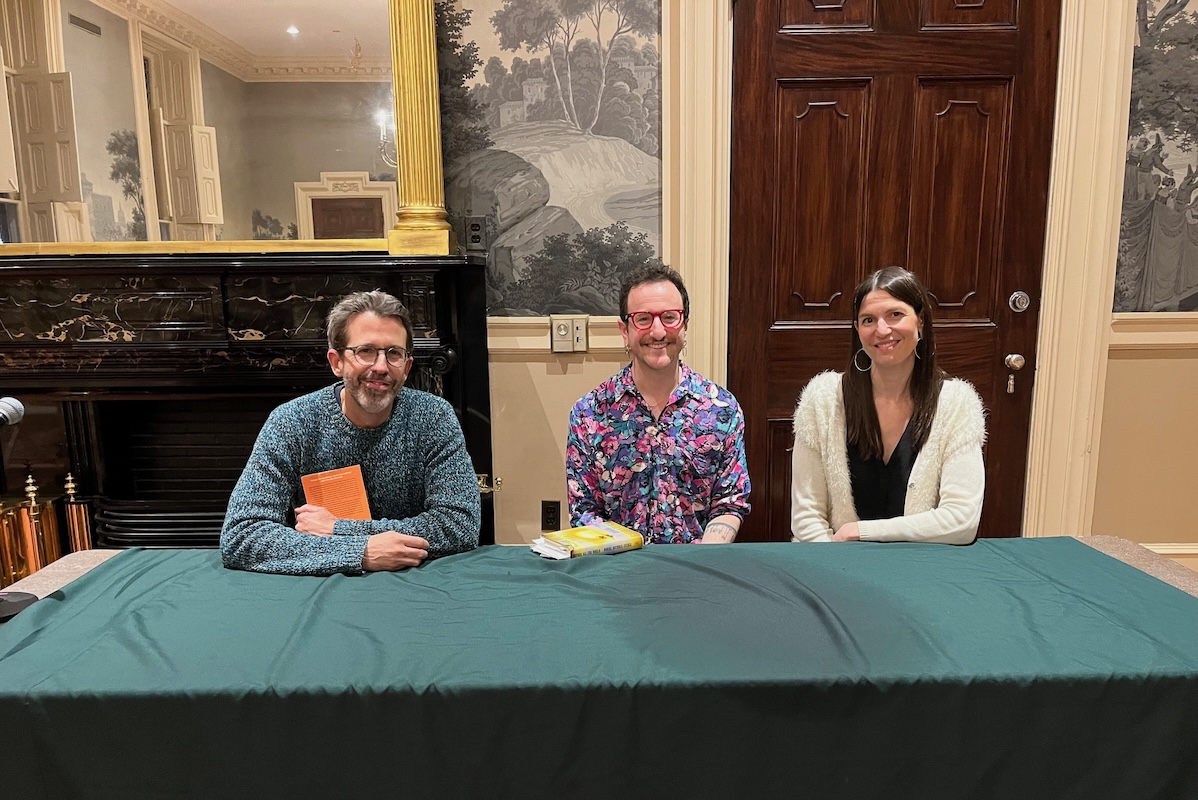
Moriel Rothman-Zecher, an Israeli-American writer, is a National Book Foundation ‘5 Under 35’ Honoree, and recipient of two MacDowell Fellowships in Literature. He is the author of the novel Before All the World, an NPR Best Book of 2022, as well as Sadness Is a White Bird, a finalist for the 2019 Dayton Literary Peace Prize and winner of the Ohio Book Award. His poetry collection, I Still Won’t Have Known, is a forthcoming 2028 publication of BOA Editions.
Javier Fuentes is a Spanish-American writer and recipient of fellowships from Columbia University, Ucross Foundation, and Lambda Literary. His debut novel, Countries of Origin, won the 2024 PEN/Hemingway Award, with his work appearing in The Columbia Journal, The Virginia Quarterly Review, World Literature Today, and elsewhere. He currently teaches at the Bard Prison Initiative as the Paris Review Professor of Literature.
The event was moderated by Drew’s Associate Professor of English and Director of Creative Writing Courtney Zoffness.
Rothman-Zecher began with an expressive reading of a poem in his forthcoming collection and an excerpt from his novel Before All the World, which follows the only Jewish survivors of a pogrom in the 1930s. Fuentes followed with a reading of an excerpt from his novel, Countries of Origin, the story of a young, undocumented pastry chef who self-deports to Spain.
Zoffness began the Q&A portion of the event by asking the authors how they think about the word “diaspora.”
“I think diasporism insists that you not close your eyes just because you’re yourself,” said Rothman-Zecher, explaining how it attunes you to who is unsafe and who is excluded. “Diaspora loathes the state,” he added. “It says, ‘Here is a people whose well-being matters, and here is a people whose well-being doesn’t.’ Diasporists stand against the principle of that.”
Fuentes responded with a more specific perspective. “I can’t uncouple the idea of going back to my country with the idea of being queer,” he said. “When I think of diasporic narratives, I can’t exclude my only feeling of being a foreigner…I wanted to write a book where the idea of being displaced stays with you—this notion of not feeling at home in the world.”
Both authors render queer characters in their work. Rothman-Zecher asked Fuentes, “Do you think that there is a way in which queerness is inherently diasporic?”
“I think it depends on your own experience,” said Fuentes. “To me, feeling like a foreigner in my own family is something I can’t get away from. They are deeply intertwined.”
Rothman-Zecher agreed. “My diasporist consciousness and queer consciousness are very intertwined,” he said. “Diasporism demands that you look around and ask ‘What’s off here?’”
Fuentes explained how he grew up in Spain under the dictator Franco, who forbade the speaking of Catalan. Consequently, a student in the audience asked how navigating the world in another language relates to the idea of queerness.
“The first time I had real sex was in English, not my mother tongue,” said Fuentes. “You don’t adapt to language just because you want to. Now that I’m entering my fifties, I look back and realize, your language was stolen from you.”
“The queerness I’m most interested in is queerness that is diasporist, that is repulsed by borders, is fundamentally fluid—much more complicated than the binaries we are put in at birth,” said Rothman-Zechter. “We should be thinking about the borders we are putting in ourselves and the borders we are being put in.”
Another student asked for the authors’ thoughts on being a child of immigrants, especially as a child who is queer, though they struggled to articulate a particular question.
“It takes time to understand your parents in a way you may not be able to understand them now,” said Fuentes. “There’s a lot of literature about kids who assimilate and become Americans. They lose their ability to connect in a way that feels fundamental to their parents.”
Fuentes concluded with a powerful and touching piece of knowledge. “This is an important part of who you are,” he said. “[Clarity] will come and you will be able to formulate what you aren’t able to express now.”