Ahead of U.S. Semiquincentennial, the discussion examined the current state of pluralism in America
March 2026 – As the United States approaches its 250th anniversary, Drew University presented a timely and thought-provoking panel discussion on the state of religious pluralism in America.
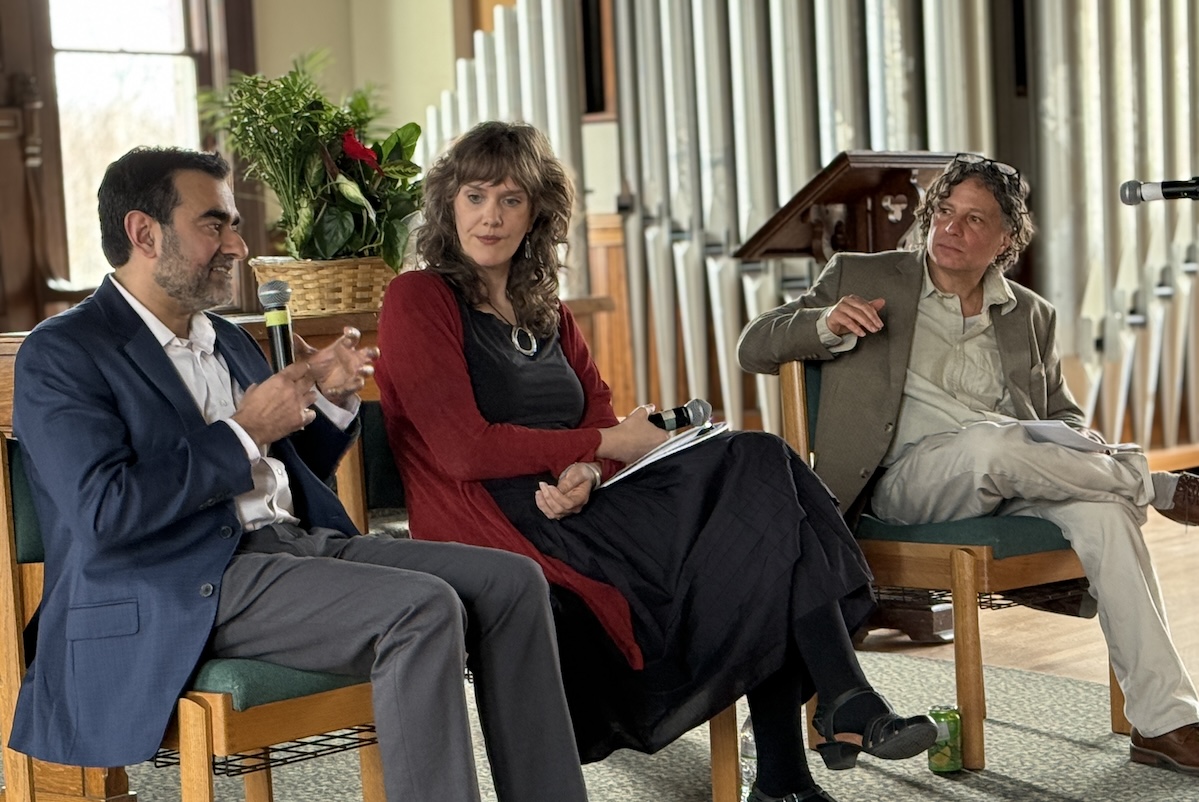
Hosted by Drew’s Center on Religion, Culture, & Conflict, US250: The State of Religious Pluralism in America, was moderated by Jonathan Golden, director of the center. Esteemed panelists included Chelsea Ebin, assistant professor of political science and international relations at Drew, and Shaun Ahmed, board chair of Penny Appeal USA and member of the Islamic Society of Basking Ridge, NJ.
Golden opened the conversation by framing the moment as both reflective and urgent. “This discussion is a good opportunity to take a look at where we are in terms of the promise of religious freedom that the founders of our nation gave to us,” he said. “And sadly, 250 years later, we have to ask this question: Are people feeling afraid?”
Pointing to recent headlines, Golden emphasized that the panel aimed to examine not only the ideals of religious freedom, but the lived realities shaping pluralism in the U.S. today.
Ebin challenged the audience to reconsider the nation’s reliance on its founding ideals as a guiding framework for the future.
“At 250 years, maybe we should stop looking to the founding,” she said. “Instead, we might begin imagining what it would look like to create a country that truly values religious pluralism.”
While acknowledging historical efforts to protect religious diversity, Ebin underscored that history also includes “violence and oppression and subjugation,” often reinforced through institutions and interpretations of the Constitution. She warned against what she described as the use of an “imagined past” to justify exclusionary visions of the present, particularly within strands of Christian nationalism.
“What if we start thinking differently?” asked Ebin. “What if we start imagining into the future and stop presuming that we have degraded as a people? Instead, take as a sort of point of empowerment that we are better and stronger because we are more diverse. We have transformed the composition of the country.”
Ahmed referenced early examples of religious inclusion, noting that the nation’s founders engaged with diverse traditions, suggesting that pluralism was part of the country’s original vision.
Ahmed also cautioned that as cultural priorities shift, the ideas that support pluralism are receiving less public attention and engagement.
“As a society, we are deprioritizing history and political understanding,” he said. “And that’s enabling a certain type of dialogue to emerge.”
Ahmed also highlighted the importance of recovering overlooked histories, including the presence of Muslims in early America. He cited evidence that a significant percentage of enslaved Africans were Muslim, underscoring the long-standing but often erased contributions of diverse religious communities.
Golden reflected on the tensions embedded within the nation’s founding documents. While figures like George Washington, Thomas Jefferson, and James Madison articulated visions of religious freedom, their actions often presented contradictions, which highlights the complexity of interpreting history as a guide for the present.
“We select moments and say this is what the history of our nation is—we claim them, we interpret them, we cherish them,” said Golden. “But others may see that same history with a very different interpretation.”
The panel discussion concluded with a Q&A session with the hybrid audience composed of students, faculty, and staff.