

Physics
From the structure of the universe to light, atoms, and elementary particles, Drew’s physics program covers it all with an eye toward flexibility to suit student interests and goals. Speaking of goals, roughly 75 percent of our amazing physics students (think national fellowships and awards) pursue advanced degrees after Drew and have ended up at schools like Brown, Columbia, Cornell, Duke, and the U.S. Naval Nuclear Program. Those that opt to jump into the job market often end up in fields like engineering, finance, and game-changing lab research. The possibilities are endless.
Related Programs
Physics (BA)
This track is most flexible to provide opportunities to explore physics broadly and is recommended for students interested in careers in business, finance, medicine, law, education, science policy/communication, etc. Students can take a wider range courses, such as astronomy, energy and environments, etc.
In addition to common courses, students will take:
- 1 course in PHYS-1xx or higher
- 1 course in PHYS-2xx or higher
- 1 course in PHYS-3xx
Physics (BS)
This track is most focused in the discipline of physics and recommended for students interested in careers in research and development in diverse areas of physics.
In addition to common courses, students will take:
- Advanced mathematical methods (PHYS-321)
- Computer Programming (CSCI-149/150/151)
- Upper-level physics courses in Quantum Mechanics, Electrodynamics, Thermodynamics, Optics, etc.
Physics Minor
The Physics Minor program is also available.
Announcement:
We are excited to announce that our Physics Department is now officially associated with the Experimental Neutrino Program at CERN, the European Organization for Nuclear Research and the world’s largest and most advanced particle physics laboratory, home to the Large Hadron Collider — the most powerful “microscope” for probing the smallest building blocks of matter and a “telescope” into the fundamental workings of the universe. This collaboration opens world-class research opportunities for our students, including hands-on involvement in cutting-edge experiments, data analysis, and international scientific exchange. Students interested in participating in this exceptional research experience are encouraged to reach out to Prof. Kamal Benslama for more information and guidance.
Announcement: Drew Particle Physics Joins the DUNE Collaboration
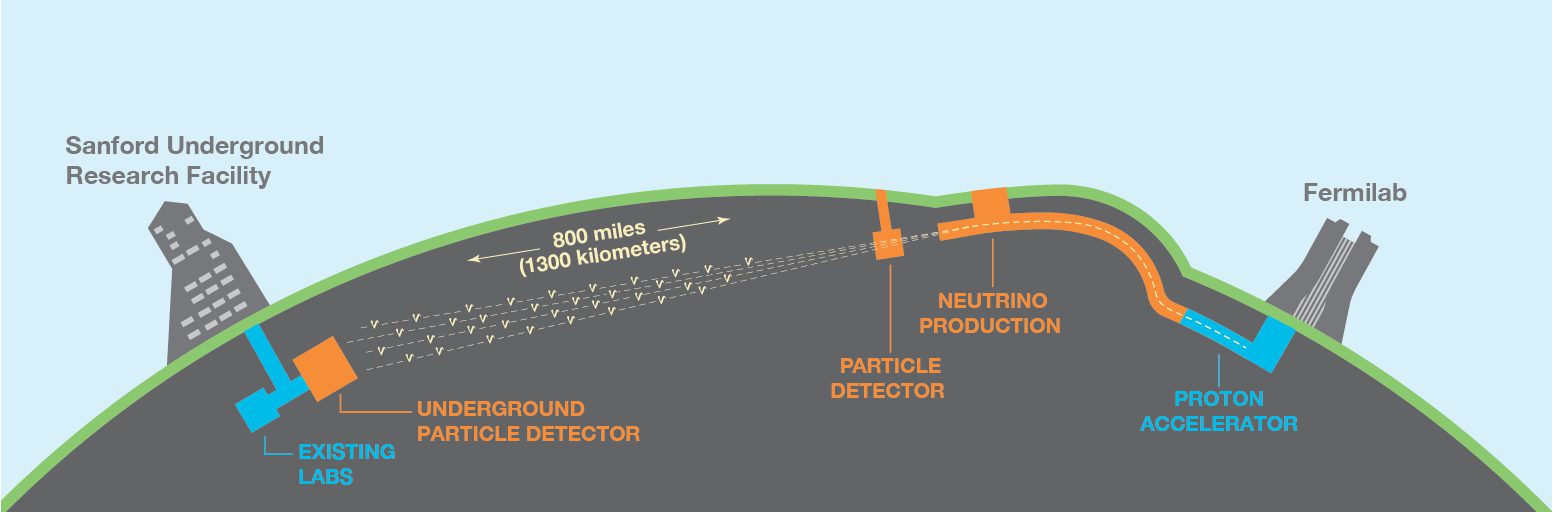
We are pleased to announce that the Drew Particle Physics Group is now an official institutional member of the Deep Underground Neutrino Experiment (DUNE), one of the world’s most ambitious and transformative scientific endeavors. This marks an important milestone for our growing research program and opens new opportunities for our students and faculty to contribute directly to cutting-edge discoveries in neutrino physics and fundamental science.
About DUNE
DUNE brings together scientists, engineers, students, and institutions from across the globe to advance our understanding of neutrinos—mysterious, abundant particles that may hold the key to answering some of the most profound questions in science. For more details about the experiment, check the DUNE Experiment.
For more information about the Drew Particle Physics Group and how to join, please contact Prof. Kamal Benslama at [email protected].
Latest News
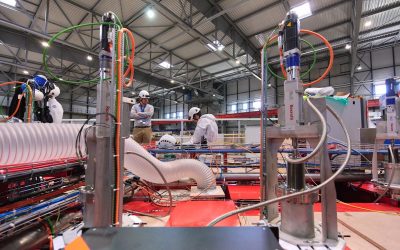
Drew University Enters International Research Partnership with CERN
Largest particle physics lab in the world, site of the Large Hadron Collider

Drew University Student Receives TEAM-UP Together Scholarship For Physics
Andzani Mthenjane: “Physics at Drew has been exciting, engaging, and full of discovery.”
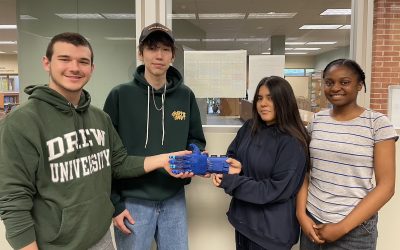
Drew University Engineering Class 3D Prints Prosthetic Hands
Students mirrored professional engineering standards throughout project