The reading series kicked off the fall semester
October 2025 — Drew University’s Writers@Drew reading series opened the fall semester featuring acclaimed authors Idra Novey and Natasha Rao.
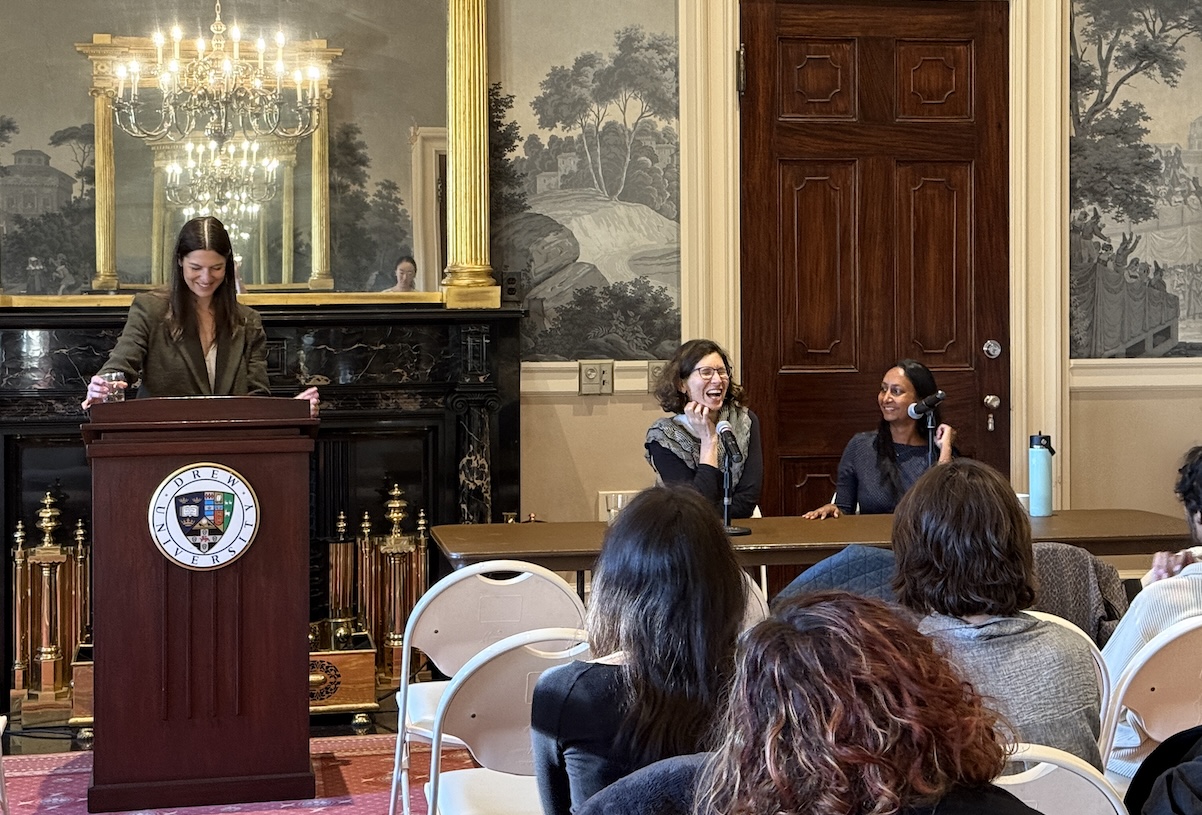
Writers@Drew, a free event co-sponsored by The Casement Fund and Drew’s English Department, hosts a variety of published authors who recite excerpts from their work for the Drew community throughout the academic year.
Idra Novey, a writer and translator, read a passage from her most recent novel, Take What You Need—a New York Times Notable Book of 2023, finalist for the Joyce Carol Oates Prize, longlisted for the Dublin Literary Prize, and named a Best Book of the Year by The New Yorker, The LA Times, The Boston Globe, NPR, and Today.
Natasha Rao, adjunct professor of poetry at Drew, read several new poems alongside selections from her debut collection, Latitude, which won the 2021 APR/Honickman First Book Prize, selected by U.S. Poet Laureate Ada Limón.
Following the readings, students joined Novey and Rao for a Q&A moderated by Associate Professor of English and Director of Creative Writing Courtney Zoffness. The discussion touched on themes of place and intentionality, the creative process, and the emotional balance between private expression and public publication.
Zoffness noted that both authors pay close attention to landscape and nature in their work and asked them to speak about it.
Novey reflected on growing up in the mountains of Western Pennsylvania and how her perspective changed after moving to Chile. “I grew up in a place people called mountains—until I lived in Chile and realized, oh, those were hills,” she said. “Leaving where you live changes your sense of scale—what’s large and what’s small. Camping in the Andes is totally different from [camping in] Western Pennsylvania, but there’s mining and environmental destruction in both. I’m interested in people’s relational way of perceiving place—what they value and don’t value.”
Rao shared how her academic background shaped her writing. “I’ve always been fascinated with the natural world and the environment,” she said. “I double majored in literary arts and environmental science and thought I’d be an environmental scientist—until I became obsessed with writing about the environment and blending the two. I spend as much time outside as possible, and that just finds its way into my poems.”
A student asked how the authors write convincingly in settings outside their own experience.
“You don’t have to have lived what your characters are living, but you have to feel what they’re feeling,” responded Novey. “Writing is about drawing from your experiences to conjure the world convincingly.”
“Observing and recording your surroundings—small moments, creatures, landscapes—creates a foundation,” added Rao. “That’s how you make writing believable.”
Another student asked how the authors balance intentionality with spontaneity in their writing.
“It’s the dialectic between intention and spontaneity,” said Novey. “In a novel, if you change one thing, it affects everything else—so you have to let go of initial instincts and let the story or poem live on its own terms. Staying too determined means it hasn’t come to life yet.”
“Writing a book of poems involves iterations—writing, putting it away, coming back,” answered Rao. “In fiction, it’s similar but more interconnected. You trust where you’re going, let go, and see where the work naturally flows.”
A student, whose work will be published, asked how the authors handle the mental preparation knowing their work will be shared publicly.
With social media, “the line between public and private is blurred now,” offered Novey. “You never know who’s seeing your work—it could go viral or be read by two people. You have to accept that and focus on making your work public when you’re ready. Even after publication, you can continue revising; it doesn’t have to be final.”
“It’s a positive experience,” encouraged Rao. “Publishing is a choice—you’re sharing something you’re proud of. The exposure we experience now is unavoidable, so it helps to focus on the work itself and trust your process.”
About Idra Novey
Idra Novey is a writer and translator. Her most recent novel Take What You Need was a New York Times Notable Book of 2023, a finalist for the Joyce Carol Oates Prize, longlisted for the Dublin Literary Prize and chosen as a Best Book of the Year with The New Yorker, The LA Times, The Boston Globe, NPR, Today, and as a Barnes & Noble Fiction Pick. Her co-translation with Ahmad Nadalizadeh of Iranian poet Garous Abdolmalekian, Lean Against This Late Hour, was a finalist for the PEN America Poetry in Translation Prize in 2021. Her work has been translated into a dozen languages and her most recent book of poetry, Soon and Wholly, is newly out in paperback. She’s written for The New York Times, The Atlantic, The Washington Post, and The Guardian.
About Natasha Rao
Natasha Rao is the author of Latitude, which was selected by Ada Limón as the winner of the 2021 APR/Honickman First Book Prize. The recipient of a Ruth Lilly and Dorothy Sargent Rosenberg Fellowship from the Poetry Foundation, she has also received fellowships from Bread Loaf, the Sewanee Writers’ Conference, the Vermont Studio Center, and the New Jersey State Council on the Arts. Her work appears in The Nation, American Poetry Review, The Atlantic, The New York Times Magazine, and elsewhere. She is currently Co-Editor of American Chordata and teaches poetry at Drew University.