The author and foreign correspondent discussed his career and latest book
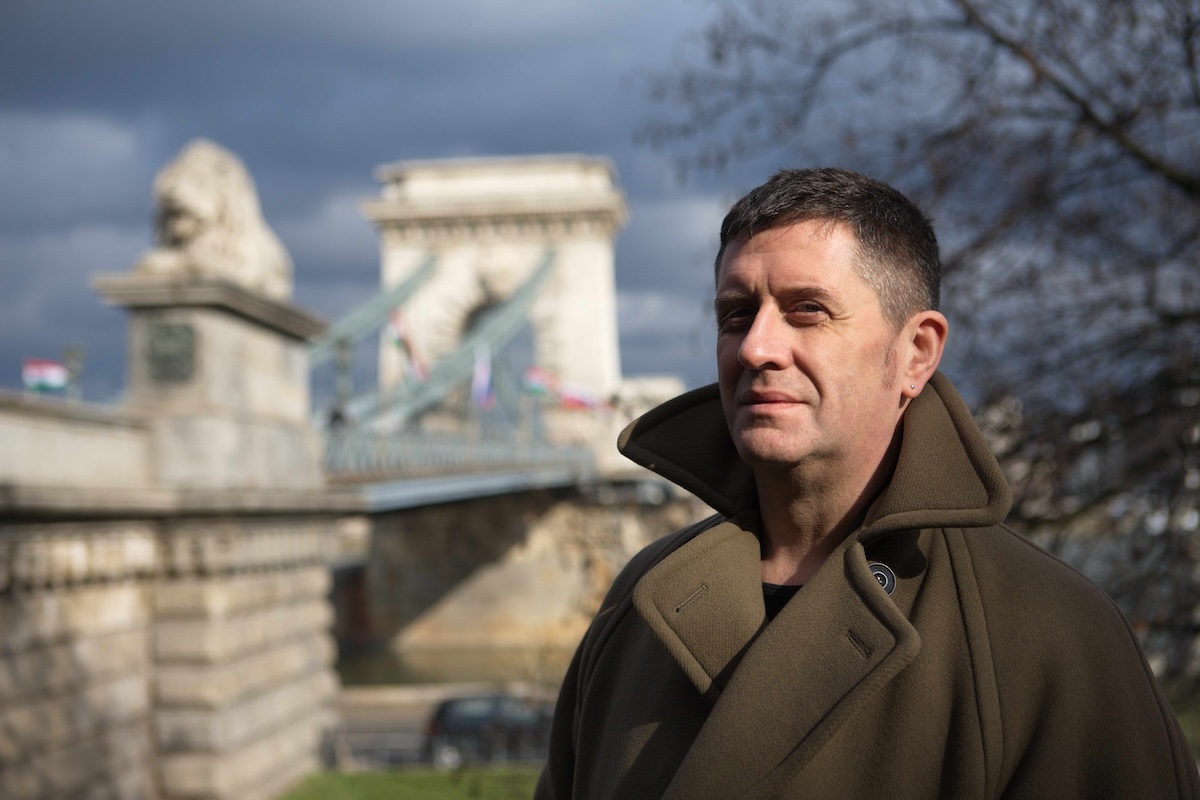
May 2026 – Drew University welcomed author and foreign correspondent Adam LeBor as the 2026 George and Alicia Karpati Lecturer.
LeBor discussed his writing process, the current state of Hungary, and latest book, The Last Days of Budapest: The Destruction of Europe’s Most Cosmopolitan Capital in World War II, in a conversation with Drew University President Hilary L. Link, PhD.
How does he balance being a writer of both fiction and nonfiction?
“I think they feed off each other. I think sometimes writers get stuck in a groove but you want to develop as a writer so you have to stretch yourself a bit and challenge yourself a bit…(In The Last Days of Budapest) I used a lot of the techniques I used as a thriller writer which is characters, motivations, missions, cutaways, building up suspense. And I think it works. As a writer, it’s very good to test yourself and push yourself in different directions and try different things. As a journalist, you’re trying to explain everything…in fiction you have to do the opposite.”
Why is Hungary one of the safest places in Europe for Jews now?
“Under Viktor Orban, the government took a decision some years ago to have very good relations with Israel and to make it clear that antisemitism was not allowed, was not accepted. That very much accelerated after October the 7th. After October the 7th, Hungary was one of the most reliable allies of Israel. That went from high politics in the UN and the European Union standing by Israel solidly to allowing Israeli football matches to take place in Budapest because, obviously, during the war foreign football teams wouldn’t go to Israel. Just a very strong message from the top that we look after our Jewish people, we protect them, antisemitism is not allowed, is not happening here, and we stand by Israel…It’s an irony that the safest palace to be Jewish now is the graveyards of Jewry.”
On what surprised him while researching and writing The Last Days of Budapest…
“The most surprising thing I found out, for me as a British person, which I really couldn’t get my head around for a while, was that we, Britain, had a fully-functioning embassy in Budapest until April 1941. And you think, well, how did that work, because in November 1940 Hungary joined the Axis Powers and was properly, legally, diplomatically aligned with Nazi Germany and fascist Italy and imperial Japan. So, it was very strange…Hungary didn’t actually go to war with Britain. Hungary actually let Britain have this big embassy in Budapest and at that time Hungary had a border with Poland, so tens of thousands of Polish soldiers came into Hungary and some of them stayed, and Jewish refugees as well, but most of them went west to Yugoslavia and then on to fight with the free Polish forces. Hungary was sort of saying, yes, we allied with Germany because the Reich is next door and Germany is next door and there’s not much we can do about it, but we want to keep a channel open to Britain and America…We grew up learning about World War II. I had no idea Britain was running a resistance in Hungary. None. Zero. To unpeel that story and tell that story, I was very happy to do that.”
How did Hungary’s linguistic isolation impact the country’s historic policies?
“It is an island of a language. It’s not really connected to any other languages…I think that does contribute to the Hungarian mentality of feeling that they’re a bit special, because they are. But I also think it can produce a certain insularity because they’re very focused on Hungarianness—generally in a positive way because it’s positive to keep your national identity especially now in a globalized world—but that can also mean a certain tendency to look inward a bit too much rather than outward. These are generalizations, but I think, yes, that probably affected the policy in the 1930s and 1940s that there was an unwillingness to understand what forces were being unleashed. You can’t do this balancing act of always thinking on the one hand we can align with Germany to get some of our lost territories back, but on the other hand we can allow the British embassy to run secret intelligence service operations into Poland with a wink and a nod. After a while you have to take a side. After all they did take a side, the German side.”
The Karpati Lectureship was established in 2005 by Michael and Noémi Neidorff in honor of Noemi’s parents. The lectureship brings outstanding authors in Jewish/Holocaust studies and Eastern European history to Drew.