Story by the Drew Acorn’s Gillian Sampson C’24, G’26
March 2026 – The Drew University community celebrated Women’s History Month on March 19 with an evening of dance history and lived experience that brought two powerful voices to the stage: Jennifer Jones and Sheila Rohan. Their conversation traced parallel journeys through exclusion, resilience, and ultimately transformation in the world of American dance.
Enlarge
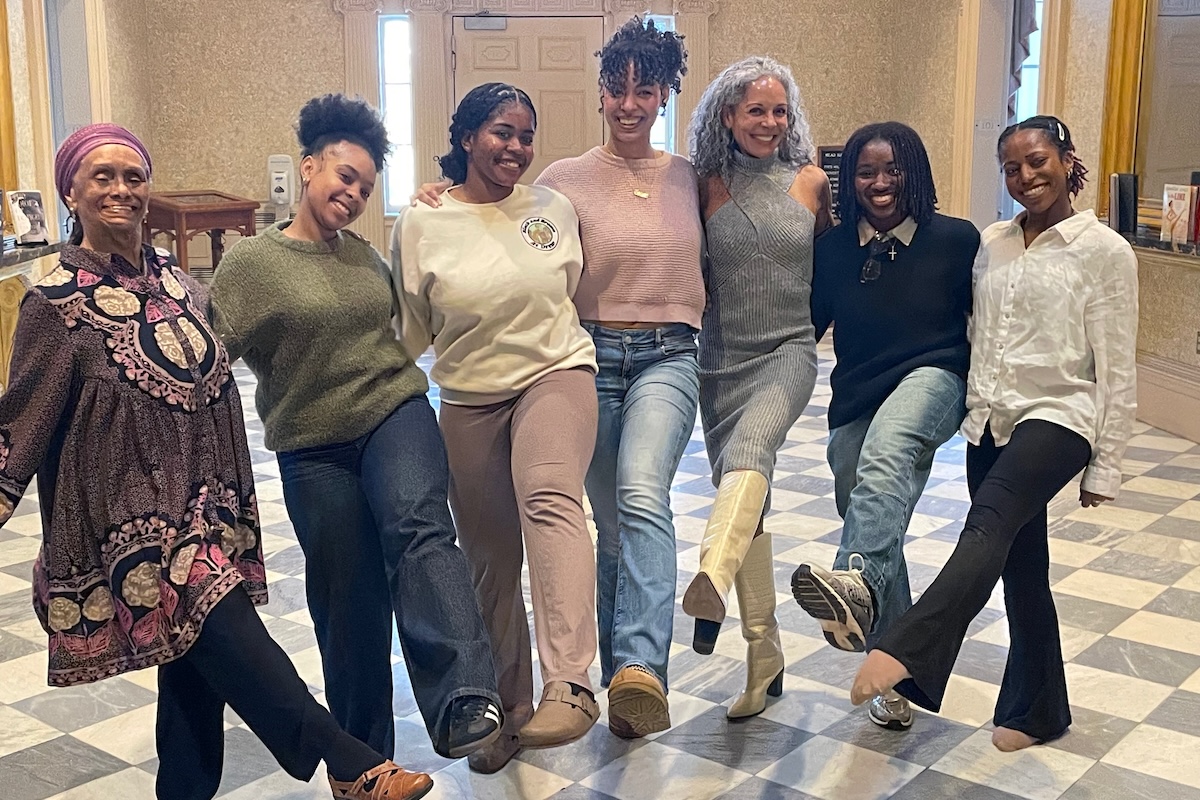
Hosted by the Drew University Bookstore in collaboration with Africana Studies, women and gender studies, theatre and dance, the Center for Civic Engagement, and the Dean’s Office, the event brought together students, faculty and community members for a night of reflection, storytelling, and performance.
The program allowed both Rohan and Jones to share about their groundbreaking careers. The impact of their stories reflected in the question-and-answer session that immediately followed.
Rohan, a founding ballerina of the Dance Theatre of Harlem, joined the company in 1969 at age 27 and quickly became part of a cultural movement that reshaped classical ballet. A survivor of the polio epidemic, dance became a source of physical therapy that quickly turned into a passion.
Touring across the United States, the Caribbean, and Europe, she performed both ballet and modern works, later serving as a soloist and ballet mistress with the Nanette Bearden Contemporary Dance Theatre. Her international teaching and performance career has taken her as far as Japan and China, and she later instructed students at the Alvin Ailey American Dance Theater School. Rohan is also featured in the book “The Swans of Harlem,” which chronicles the early years of Dance Theatre of Harlem and the women who defined it.
Jones made history in 1987 when, at just 19 years old, she became the first African American Rockette at Radio City Music Hall. She performed for the first time with the Rockettes at the 2022 Super Bowl halftime show. Her achievement, however, was not met with universal celebration. As she shared with the Drew audience, many within both the lineup and management resisted her presence. The Rockettes had long been defined by uniformity, height, body type and even skin tone, and Jones’s entry disrupted that tradition.
Jones’ love for dance began long before Radio City. She recalled a formative moment in a fourth-grade recital: “the curtain went up, and I felt like I was at home.” That sense of belonging became her anchor through years of resistance. She trained at the Broadway Dance Center and pursued her passion for Broadway, eventually performing in high-profile productions including the 2022 Super Bowl halftime show. Even in environments that felt unwelcoming, she emphasized, no one could take away her love for dance.
One of the most striking moments of the discussion centered on something seemingly small but deeply symbolic: tights color. The Rockettes’ signature look required dancers to wear “flesh-toned” tights—tones that historically only matched white skin. For Jones, this created an immediate visual marker of difference. The expectation of uniformity clashed with the reality of diversity, exposing how even costume design can reinforce exclusion. Her presence forced a reconsideration of what “uniform” truly means, not just aesthetically, but culturally.
The evening continued with a dance performance by Drew student Aziza Hopkins, whose work paid tribute to the legacy of the honorees. “Getting the opportunity to dance and share art with two groundbreaking Black dance pioneers was a wonderful experience I’ll never forget. It is because of them that I will be able to get the professional training and opportunities that would not have been open to me 70 years ago,” Hopkins said when reflecting on her experience. “ As a dancer and aspiring choreographer, art has been, and always will be, activism. It is up to the newer generations to continue this work of breaking barriers, overcoming adversity and proving racist stereotypes wrong.”
The Pioneers in Dance event not only celebrated the accomplishments of Rohan and Jones, but also highlighted the ongoing influence of their work on the next generation of artists, reinforcing the vital connection between art, history and social change.