A contemplative journey toward awareness, clarity, and embodied learning
November 2025 – Students and faculty in Drew University’s Medical & Health Humanities graduate program gathered for Walking the Drew Labyrinth, an event blending contemplative learning, embodied practice, and reflection.
Led by Adjunct Professor of Contemplative Studies Erin Sheehan, the event invited participants to explore how contemplative practices support awareness and professional purpose.
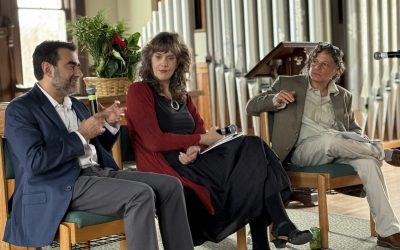
The program opened with a conversation between Sheehan and Program Director Merel Visse, who introduced the labyrinth walk as part of the program’s emphasis on ethical, creative, and embodied forms of knowing.
Sheehan described her own introduction to labyrinth walking during a contemplative retreat in 2024, guided by a Quaker Buddhist teacher. She found the movement-based meditative practice unexpectedly transformative and inspired her own dissertation research. “What’s really interesting is that it’s embodied and it’s ecological as well,” she said. “It offers multiple pathways of self-discovery that are really important for today’s adults.”
She also described how the research she has conducted with Drew students emphasizes that contemplative pedagogy is not only about mindfulness but about trauma awareness, embodiment, relational ethics, and how adults make meaning in their professional lives.
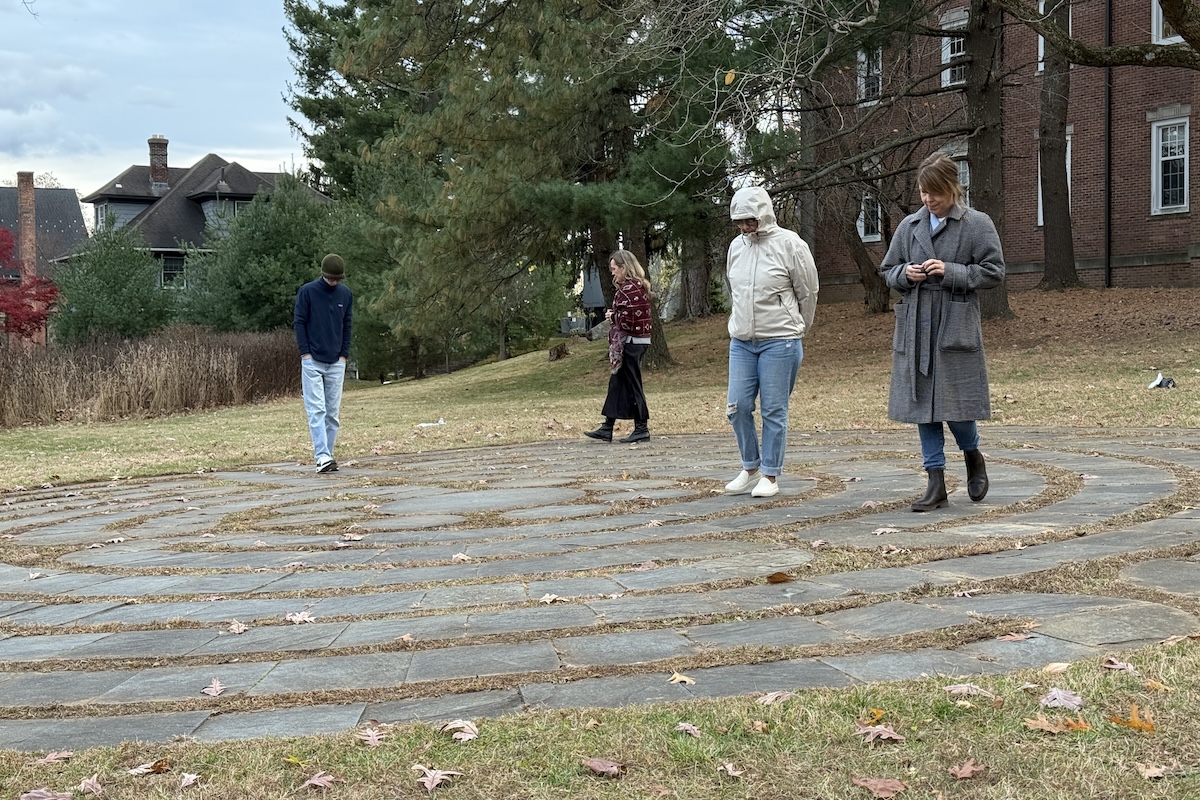
Participants then moved outside to the Drew labyrinth, located on the lawn between the Hall of Sciences and Madison Avenue. Installed in 2014 by stone carver Gabriele Hiltl-Cohen. Drew’s labyrinth is created from reclaimed bluestones, the design is modeled after the medieval labyrinth at Chartres Cathedral in France.
Whether walked alone or with others, the circular pattern of the labyrinth offers a moving meditative experience. Participants may walk at different paces, pause as needed, or offer a small natural object at the center. “There’s no right or wrong way to walk the labyrinth,” said Sheehan. “Notice what’s there.” That way, students learn how to discern better, a crucial skill in humanities research, which encourages wonder and openness to multiple and new perspectives.
After the labyrinth walk, attendees reconvened for reflections. “You don’t need a goal or intention, you just need to be present,” said Sheehan.
Robustly interdisciplinary, Drew’s Medical & Health Humanities program encourages explorations of how health and medicine, with care at their center, are constructed, experienced, and practiced—socially, historically, ethically, politically, legally, and organizationally—recognizing that health problems are shaped by forces extending far beyond the clinical encounter. The program is committed to ‘involved’ learning, diversity, and inclusivity and can be completed in a full- or part-time basis. Designed with working professionals in mind, courses are offered in the late afternoon and early evening and allow for online, synchronous learning, making Drew an excellent choice for distance-based students.