Closing the spring semester with the best-selling author
April 2026 – Drew University’s Writers@Drew reading series closed the academic year featuring T Kira Madden, a diasporic Kanaka ‘Oiwi (Native Hawaiian) writer and author of the acclaimed memoir Long Live the Tribe of Fatherless Girls, named a New York Times Editors’ Choice and a finalist for the National Book Critics Circle Award.
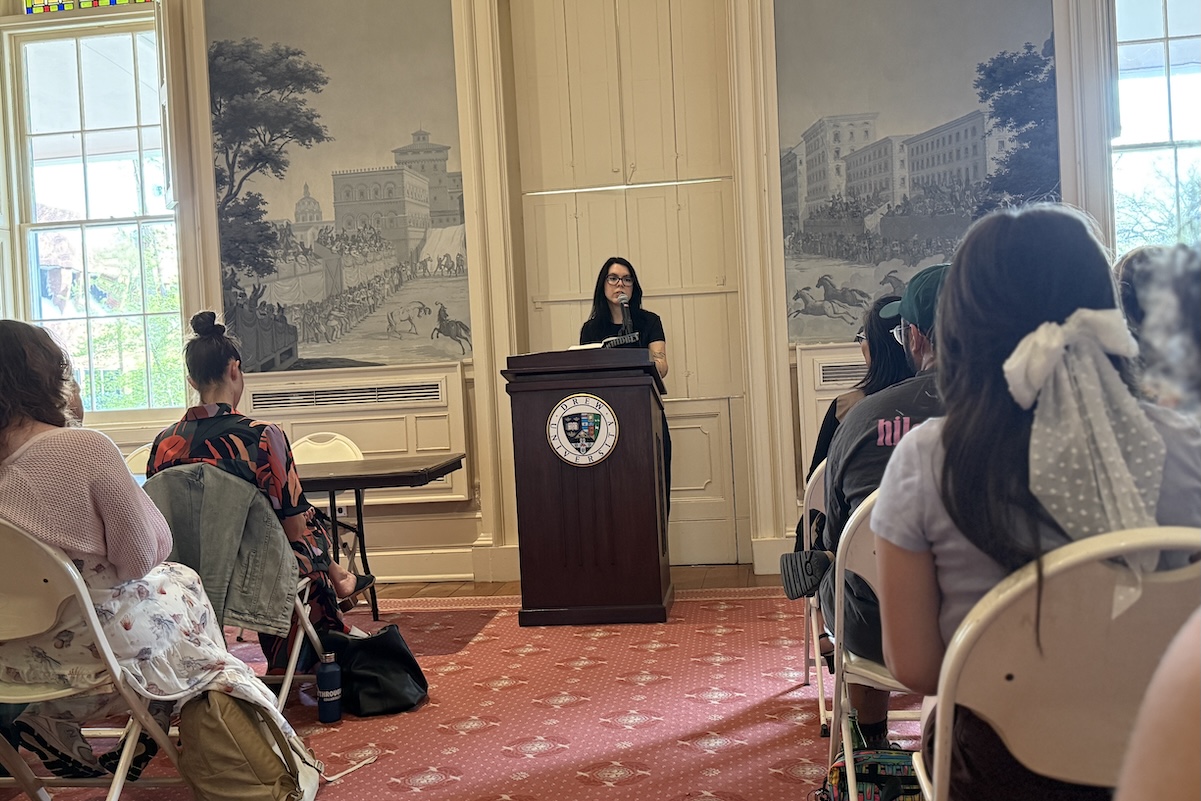
Writers@Drew, a free event series co-sponsored by The Casement Fund and Drew’s English Department, hosts a variety of published authors who read excerpts from their work for the Drew community throughout the academic year.
An assistant professor at Hamilton College, Madden’s recently-published debut novel, Whidbey, is already a national bestseller. She is the Founding Editor of No Tokens, a magazine of literature and art, and is the recipient of fellowships from the New York Foundation for the Arts, Hedgebrook, MacDowell, and Yaddo.
Following the readings, students joined Madden for a Q&A moderated by Associate Professor of English and Director of Creative Writing Courtney Zoffness.
When asked about the inciting incident for her novel and the narrative truth inside it, Madden recalled an unexpected encounter in which she confided in a stranger about her experiences of childhood sexual abuse and its ongoing impact. Elements of that exchange informed the storyline of Whidbey.
“Why did I tell this stranger something?” she asked. “What was I trying to prove to myself? Was I trying to be courageous or brave? I wanted to use that text, and kind of write into a reversal, or mirror image of it, and take that story, but populate it with women.”
Zoffness asked about the women Madden chose to inhabit and dramatize in the polyvocal novel.
“I knew early on that I wanted to investigate this idea of a ‘perfect victim’ narrative,” she explained. “In my own case I was considered a credible witness, or credible victim, because I had a book published. I was a professor in college. I could write my own victim impact statement. The other victims of the same perpetrator, and other victims in other cases, are not afforded that kind of respect and that pedestal to be the credible witness, because of their socioeconomic status, their relationship to power, or whiteness, or education, or articulation.”
“I really wanted to dismantle this idea of what makes someone believable or credible.”
When asked about the narrative arcs for all the characters, Madden described her intention to build toward a “larger-than-life, hyperbolic ending” ending, expanding from first-person narratives to a broader, omniscient perspective. “That allowed the readers to grapple with, ‘well, who do I believe now?’” she explained.
The conversation turned to Madden’s evolution as a writer. She spoke candidly about imposter syndrome and the pressure of being defined by personal trauma. “Am I only as interesting as the worst things that ever happened to me?” she recalled asking herself. “It was validating for my agent to say that [my success] isn’t about those traumatic events and writing about it in memoir, but my ability to think about humanity or my curiosity about issues of the world.”
A student asked about the research methods Madden used for the novel.
Madden highlighted the importance of immersive work, from visiting key locations to shadowing people in their professions. “I love research for any project,” she said. “My research is really talking to people and listening to them. And I really like experiential research and going to the places that I’m writing about and experiencing the sensory stuff. The most exciting research for me with this book was going to all these places, spending almost a decade visiting Whidbey Island many times—getting to know the locals and the land and the tree systems and learning as much as I could about the history.”
Another student asked what writers should keep in mind when approaching such sensitive subject matter.
“Listen to yourself,” answered Madden. “If it’s not a good day to dig into that big, heavy thing, you don’t have to. Give yourself the grace and the time to know that the story will still be there, and to allow yourself to write about other things.”