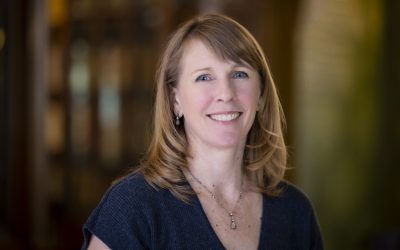
Dr. Mónica Cantero-Exojo G’24
For Professor Mónica Cantero-Exojo G’24, language is more than grammar and vocabulary. It is culture, identity, and connection. At Drew, she helps students experience Spanish not simply as a subject to study, but as a way of understanding the world.
Mónica Cantero-Exojo believes that language is best learned through experience.

“You can study vocabulary and grammar in a classroom,” she says. “But language truly comes alive when students hear it in everyday conversations, see it in the rhythms of a city, and begin to understand the cultural context that gives words their meaning.”
At Drew, that philosophy shapes everything she does as a teacher.
“My goal is to help students experience language as something lived,” Cantero-Exojo explains. “Language carries culture, identity, and history with it.”
For many Drew students, that experience begins in the classroom. But it often extends far beyond it.
Through Drew’s shortTREC program, Cantero-Exojo leads students to Barcelona, where they spend several weeks immersed in Spanish language and culture. Students attend classes, explore neighborhoods, engage with local communities, and begin to see the language they are studying as part of a much larger cultural world.
The experience can be transformative.
Students who once felt hesitant to speak Spanish often discover new confidence as they navigate daily life in another country.
“They begin to realize that language is about connection,” Cantero-Exojo says. “It’s about understanding people and perspectives that may be different from their own.”
For many students, the experience reshapes how they think about both language and themselves.
Cantero-Exojo’s passion for language education is deeply personal. As someone who has navigated multiple languages and cultures throughout her own academic journey, she understands both the challenges and the profound rewards of linguistic immersion.
“I know what it feels like to be the person struggling to find the right words,” she says. “And I know the moment when you realize you’re no longer translating in your head—you’re just speaking, just connecting. That’s the moment I want every student to experience.”
She also knows that for some students, access to that kind of experience is not guaranteed.
“Some of my most talented students—the ones who would benefit most from immersion—are the ones who can’t afford to go.”
In Barcelona, the classroom expands beyond traditional academic spaces.
Students encounter art, architecture, music, and everyday conversations that reveal how language reflects cultural values and lived experience. They see how the Spanish they study in class exists within a vibrant, dynamic community.
Moments like these often spark new curiosity.
Students begin asking deeper questions about history, identity, and global culture. They notice differences in communication styles, social customs, and ways of understanding the world.
The process encourages them to think more critically about their own cultural assumptions.
Language becomes a bridge between worlds.
Back at Drew, Cantero-Exojo continues to build those connections in her courses.
Students explore Spanish literature, film, and cultural history while also engaging in conversations that help them reflect on their own experiences. The goal is not merely fluency, but understanding.
“Learning a language is also about learning to listen,” she says. “It helps students develop empathy and curiosity.”
Those qualities are essential in an increasingly interconnected world.
Drew students come from many different backgrounds and pursue a wide range of careers after graduation. Yet the ability to communicate across cultures remains one of the most valuable skills they carry with them.
Whether students go on to work in education, business, healthcare, or public service, the perspective they gain through language study often shapes how they approach the world.
Programs like shortTREC are made possible through the support of alumni and donors who believe in the power of experiential learning.
For students like those in Cantero-Exojo’s courses, that support helps turn possibility into reality. It opens the door to experiences that build confidence, deepen understanding, and allow them to fully engage with another language and culture.
Travel scholarships and program support help ensure that students from many different backgrounds can participate in these opportunities.
For Cantero-Exojo, those opportunities represent one of the most meaningful aspects of teaching.
Watching students discover new confidence in another language and culture reminds her why the work matters.
Students arrive unsure of their abilities.
They leave knowing they can navigate unfamiliar places, communicate across cultures, and see the world from new perspectives.
At Drew, language learning is never just about mastering a new set of words.
It is about discovering the connections that bring people together.
Because when students learn another language, they are not only translating sentences.
They are expanding their understanding of the world.
Experiences like these are made possible through the support of alumni and donors who believe in the power of a Drew education. As the fiscal year comes to a close, your support helps ensure that future students continue to discover their curiosity, confidence, and purpose at Drew.