Dr. Roger Knowles
For more than two decades, Professor Roger Knowles has helped Drew students explore one of science’s greatest mysteries: the human brain. Along the way, he has invited them into research that asks urgent questions about diseases such as Alzheimer’s and about how scientific discovery begins.
Rogers Knowles still remembers the moment that set him on his path.
As a college student, he watched a close friend’s grandmother struggle with Alzheimer’s disease. When he met her at graduation, she no longer recognized members of her own family.
The experience stayed with him. It raised a question that would shape the course of his career.
How does the brain work, and why does it sometimes fail?
The search for answers led Knowles from West Point, where he first studied as an undergraduate and later served in the U.S. Army, to Harvard University, where he earned a PhD in neuroscience. He went on to conduct research at the Alzheimer’s Disease Research Center at Massachusetts General Hospital before ultimately choosing a career centered on teaching.
“I love teaching,” Knowles says. “Even when I was in the Army, I enjoyed teaching my soldiers. As I finished my research fellowship, I wanted to find a place where teaching was truly valued.”
In 1998, he arrived at Drew with an unusual opportunity: to help build the university’s neuroscience program.
At the time, undergraduate neuroscience programs were still relatively rare. Drew offered something distinctive — small classes, close faculty mentorship, and the opportunity to involve students directly in research.
Over the years, Knowles has built a program where those values remain central.
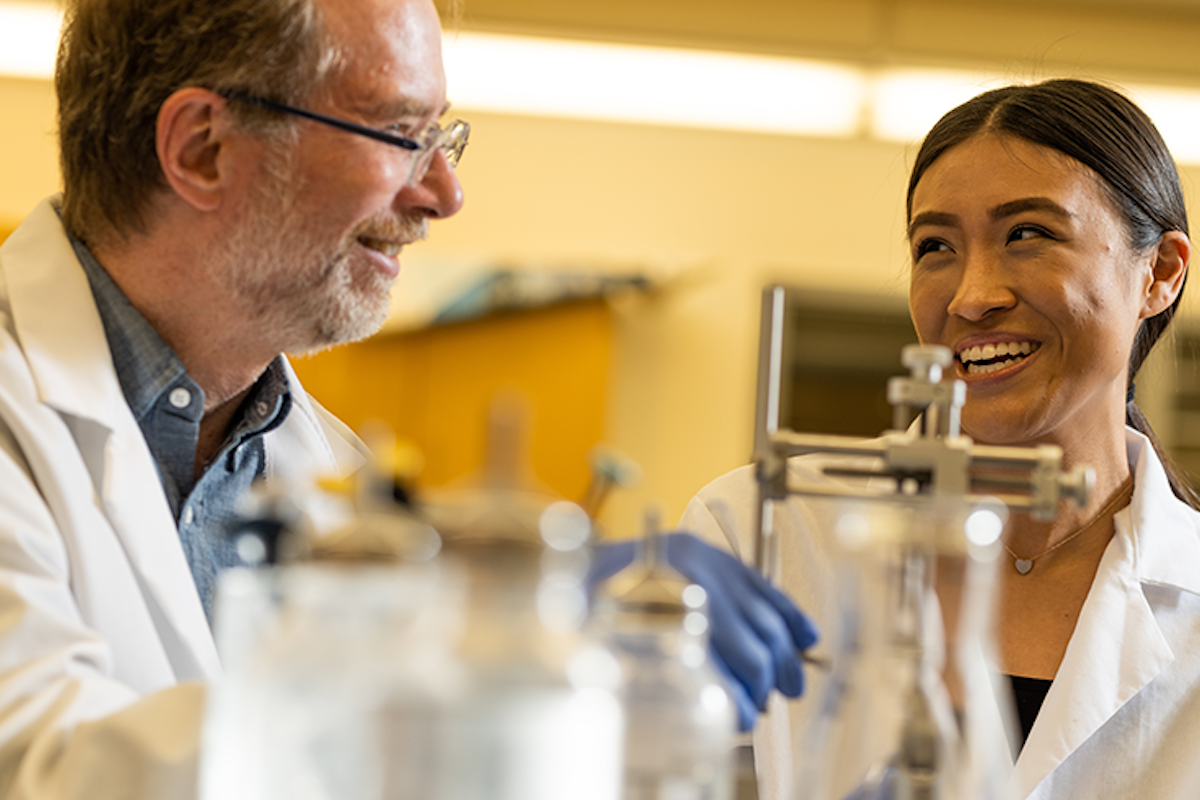
“My research is directly tied to my students and my teaching,” he explains. “In my courses, we don’t just learn about discoveries in neuroscience. Students learn how those discoveries are made.”
Today, that work focuses on one of the most pressing challenges in modern medicine: Alzheimer’s disease.
Rather than targeting the disease directly, Knowles and his students explore ways to strengthen the brain’s resilience. Their research investigates whether supporting pathways affected by aging might allow the brain to better resist degeneration.
It is serious work. And at Drew, students do not wait until graduate school to participate.
They begin as undergraduates.
For Riley Roesel, the path into neuroscience began with uncertainty.
She arrived at Drew planning to pursue a traditional pre-med track. But after shadowing at a nearby physical therapy clinic, she began to rethink what she wanted her future in healthcare to look like.
“I realized I didn’t just want to treat patients,” Riley says. “I wanted to build the kind of long-lasting relationships that physical therapists have with their clients.”
That realization prompted her to reconsider her academic direction and ultimately led her into Knowles’s Introduction to Neuroscience course.
“Taking Intro to Neuroscience with Dr. Knowles was a turning point for me,” she says. “His passion for the subject was infectious, but it was his mentorship outside the classroom that truly shaped my path.”
During a period when she was questioning her direction, Riley reached out to him for advice. Together, they explored how her interests in chemistry and healthcare might intersect. The result was a decision to pivot toward a neuroscience major.
“It has since opened doors I hadn’t even considered,” she says.
Today, Riley’s research bridges those disciplines. Drawing on her background in chemistry, she synthesizes compounds that are tested within Knowles’s neural cell models to explore potential approaches to slowing neurodegeneration.
“Bridging the gap between organic chemistry and neuroscience has been incredibly rewarding,” she says. “I believe this interdisciplinary approach is essential for my future career in healthcare.”
The experience has reshaped how she sees herself academically.
“This research has shifted my mindset,” Riley explains. “It replaced self-doubt with newfound confidence in my abilities. It proved to me that ‘researcher’ is a title I can earn.”
Balancing laboratory work with life as a student-athlete has required discipline and resilience, but Riley credits the mentorship she found at Drew with helping her grow both intellectually and personally.
“The research environment here is truly unique,” she says. “Students have the opportunity to collaborate with faculty and explore meaningful research much earlier than they might expect.”
Experiences like Riley’s are exactly why Knowles believes undergraduate research matters.
Another student, April Kusnier, discovered her interest in neuroscience after enrolling in Knowles’s introductory course. A Baldwin Honors student and member of Drew’s cross-country and track & field teams, April quickly became interested in the research questions being explored in the lab.
With Knowles’s encouragement, she pursued a summer internship with a neuroscientist at a laboratory in Morristown, where she gained additional experience working in a professional research environment.
Opportunities like these allow students to see science not simply as a subject they study, but as something they can actively contribute to.
For Natalie Bailey, the journey looked different.
She first enrolled in Introduction to Neuroscience simply to fulfill a breadth requirement. At the time, she hadn’t taken any of the courses typically required for a pre-med pathway.
But something about the course sparked her curiosity.
Knowles met with her to discuss her interests and helped map out an ambitious plan to complete the necessary pre-med coursework during the final year and a half of her time at Drew. Along the way, he mentored her through an independent study focused on biomarkers connected to Alzheimer’s research.
That experience opened possibilities she had not previously considered.
Again and again, Knowles has watched students discover that they are capable of more than they initially imagined.
“The biggest change I see in students is confidence,” he says. “The idea of doing original research feels daunting to first-year students.
By the time they reach their junior and senior years, they relish the challenge.”
For him, those transformations are among the most rewarding parts of teaching.
Research opportunities like these require resources.
Laboratory equipment, materials, and research support all come with real costs. At many institutions, such opportunities are reserved primarily for graduate students.
At Drew, donor support helps ensure undergraduates can take part in the work.
“Nearly every student who has gone on to medical school or pursued a PhD in the sciences from Drew has had meaningful laboratory research experience,” Knowles says. “Those experiences simply would not be possible without donor support.”
The impact extends far beyond the laboratory.
Students gain confidence. They learn to ask questions. They discover how knowledge is built.
And they carry those lessons into careers in medicine, science, and public service.
For Knowles, that is the true reward.
The search to understand the brain continues. Alzheimer’s remains one of the most complex challenges scientists face.
But every year, new students step into the work.
They learn how research happens. They learn how collaboration works. They learn how discovery begins.
Because scientific breakthroughs rarely begin with certainty.
They begin with curiosity — and a professor willing to help a student pursue it.
Experiences like these are made possible through the support of alumni and donors who believe in the power of a Drew education. As the fiscal year comes to a close, your support helps ensure that future students continue to discover their curiosity, confidence, and purpose at Drew.