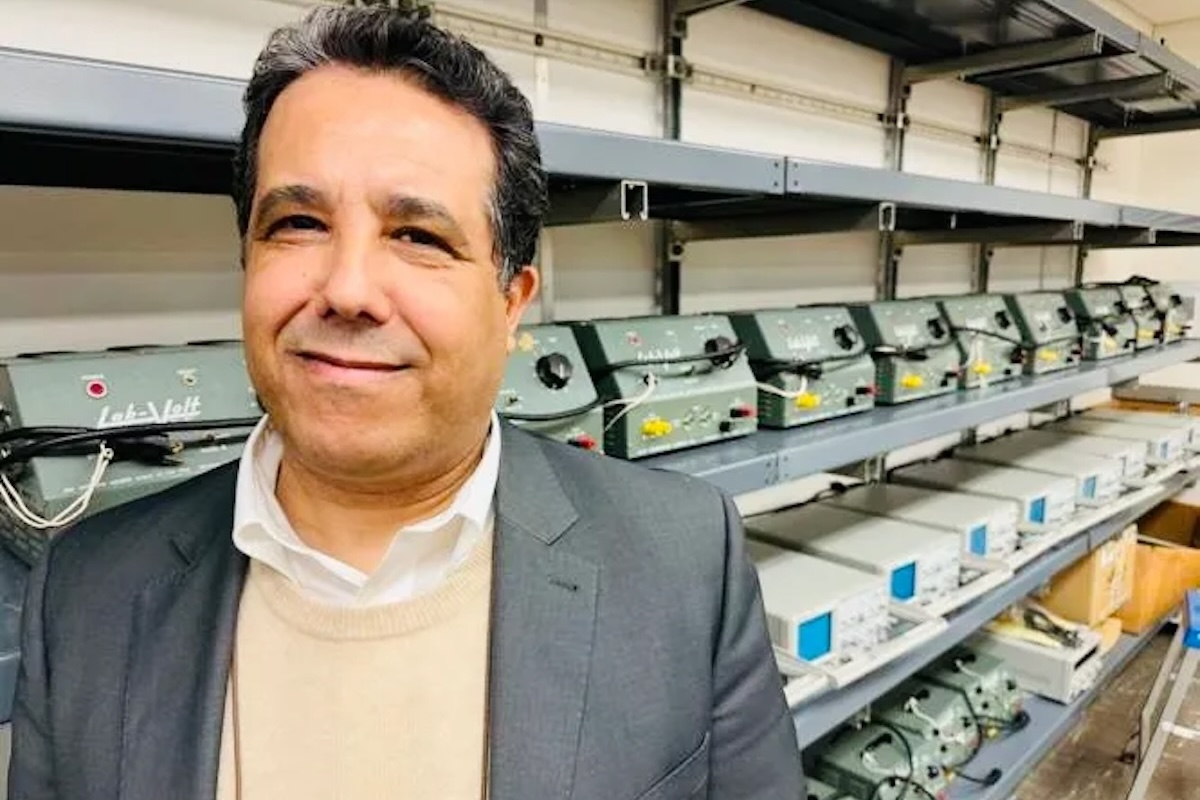
Dr. Kamal Benslama
Particle physicist Kamal Benslama invites Drew students into the frontiers of modern science. Through collaborations with major international laboratories, students participate in research that asks fundamental questions about the universe.
For Kamal Benslama, the most exciting questions in science often begin with a mystery.
One of the questions that has driven his research for decades is deceptively simple: why does the universe exist in the form that it does?
Particle physics attempts to answer questions like this by studying the smallest known building blocks of matter and the forces that govern their behavior. The work is complex, collaborative, and often global in scope.
At Drew, Benslama brings students directly into that process.
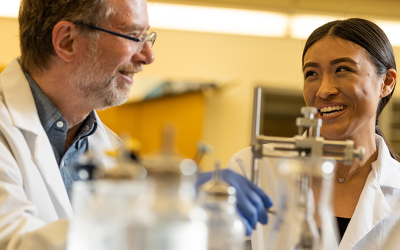
Rather than waiting until graduate school, Drew undergraduates participate in research connected to major international scientific experiments. Under Benslama’s mentorship, students have contributed to projects at Fermilab in the United States and at CERN in Switzerland, working alongside scientists from institutions around the world.
For many of them, it is the first time they realize they can play a role in advancing human knowledge.
They are not simply studying science. They are practicing it.
For Henry Arthur C’23, that opportunity came unexpectedly.
A computer science student with a long-standing curiosity about physics, Henry was introduced to Benslama through a recommendation from a faculty member in another department. The connection led to an invitation to join the Drew Particle Physics Group.
“I have always been fascinated by physics,” Henry says. “But I wasn’t a physics major, so it felt like an exceptional opportunity to dive into the world of experimental physics.”
That opportunity soon took him to Fermilab, where he became the first Drew student to work on-site with the Mu2e experiment, a large international collaboration searching for evidence of a rare theoretical process known as charged lepton flavor violation.
At first, the scale of the project felt daunting.
“It’s not entirely trivial to step into such an unfamiliar environment,” he says. “But that was also what made the experience so valuable.”
Henry’s work involved developing software tools that allowed scientists to run hardware tests more efficiently within the experiment’s complex systems. He also collaborated with researchers on practical challenges related to data collection infrastructure.
Some of the most meaningful work came in unexpected moments.
“I spent time working with researchers in the server room solving very practical issues related to data collection,” he recalls. “It required creative problem solving and collaboration.”
The experience reshaped how he saw research.
“You learn how to talk to scientists and how to insert yourself into the work while learning from others,” Henry explains. “That’s what’s required to do research.”
The confidence he gained helped prepare him for the next step in his academic journey: an internship with NASA.
Another student, Andzani Mthenjane, arrived at Drew already interested in engineering and scientific inquiry. What she did not expect was how quickly she would find herself working on cutting-edge research.
During the Drew Summer Science Institute, Andzani joined Benslama’s research group to explore how machine learning techniques could be applied to experimental physics data.
“I had limited experience with coding,” she says. “So stepping into a research project that relied on machine learning felt intimidating.”
Under Benslama’s mentorship, she learned to approach unfamiliar challenges with curiosity rather than hesitation.
“It often felt like being thrown into the deep end and learning how to float,” she says. “But it was an environment where you could always ask for help.”
The experience strengthened her academic confidence and connected her to broader scientific networks. Benslama introduced her to the National Society of Black Physicists, opening doors to a wider community of scholars in the field.
Research funding also played an essential role in making those opportunities possible.
“Being supported financially meant I could focus on the research itself,” Andzani explains. “It reinforced that the work had real value.”
That support helped prepare her for the next stage of her academic journey: graduate study.
“It was exciting and humbling to receive multiple graduate school acceptances,” she says. “It made me reflect on how far I had come.”
For Brendan Mullany C’25, the path into particle physics emerged through his honors thesis.
A computer science major with an interest in machine learning, Brendan joined the Mu2e collaboration to study how data quality could affect the search for rare particle interactions.
The experiment seeks evidence of charged lepton flavor violation, a phenomenon predicted by some theories of particle physics but never directly observed. One challenge is distinguishing the signal scientists are looking for from background events that may mimic it.
Brendan’s research applied machine learning methods to help separate high-quality data from lower-quality measurements, improving the clarity of the experimental results.
Initially, the scale of the collaboration felt intimidating.
“The opportunity came about in a very unexpected way,” he says. “It was surprising and exciting.”
Over time, however, he found himself contributing meaningfully to the work.
“Knowing that I was part of an international scientific collaboration was incredibly motivating,” Brendan explains. “Even when I encountered difficult problems, remembering the nature of what we were working toward helped me keep going.”
Benslama’s mentorship was central to that experience.
“When I began working with him, I had a very limited background in physics,” Brendan says. “He provided resources to help me learn the domain and connected me with people at the lab who helped me navigate the collaboration.”
Through that support, Brendan gained not only technical skills but also a new perspective on the nature of discovery.
“Being a collaborator in discovery means that you’re not just learning about knowledge,” he says. “You’re helping create it.”
For Benslama, experiences like these illustrate the power of undergraduate research.
Scientific discovery rarely happens in isolation. It emerges through collaboration, persistence, and the willingness to explore difficult questions.
At Drew, students learn those lessons early.
They work alongside faculty mentors, contribute to real scientific projects, and gain experience that prepares them for graduate study and research careers.
Those opportunities are made possible in part through philanthropy.
Travel, housing, and research materials all represent real costs for students participating in national and international experiments.
Donor support helps ensure that those opportunities remain accessible to talented students regardless of financial circumstances.
As Henry Arthur reflects, that support plays a critical role in shaping the future of science.
“Getting research experience early is incredibly important,” he says. “It helps train the next generation of scientists.”
At Drew, that training begins sooner than many students expect.
They arrive curious about how the universe works.
Before long, they find themselves contributing to the search for answers.
Because discovery does not begin only in the world’s largest laboratories.
Sometimes it begins in a small classroom where a student realizes they belong in the work of science.
Experiences like these are made possible through the support of alumni and donors who believe in the power of a Drew education. As the fiscal year comes to a close, your support helps ensure that future students continue to discover their curiosity, confidence, and purpose at Drew.