Dr. Kristen Turner
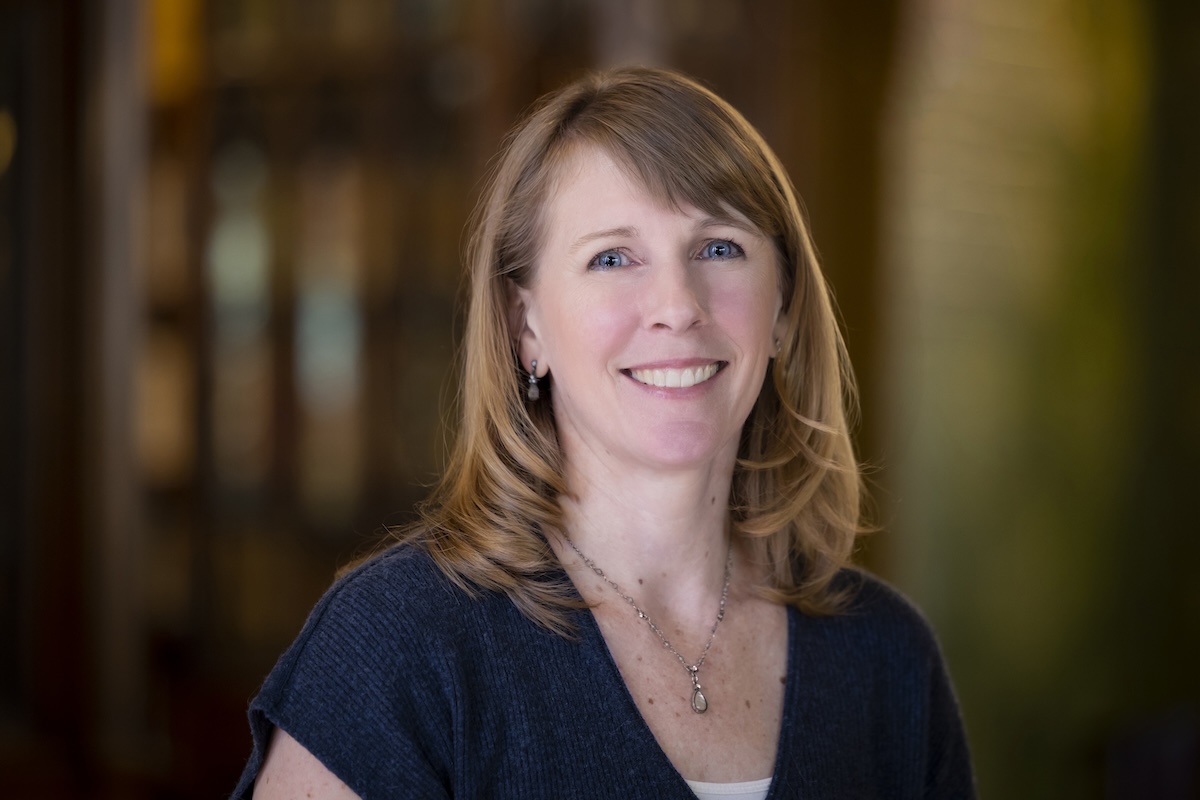
Professor Kristen Turner has spent her career studying how people read, write, and communicate in a rapidly changing technological world. At Drew, she is helping lead an effort to rethink how higher education can better prepare students for the future.
Kristen Turner has always been a teacher.
Long before she stepped into a classroom professionally, she was already practicing the role at home.
“My mom was a teacher,” she recalls. “She would bring papers home to grade, and I would sit with her and help. I was teaching my stuffed animals before I was five years old.”
That early influence set her on a path that would eventually lead her into classrooms of her own. After graduating from college, Turner began teaching high school English and social studies. The experience quickly revealed something she loved even more than teaching students.
She loved helping teachers learn how to teach.
While completing a master’s degree in curriculum and teaching at Columbia University, Turner began working with colleagues on professional development, exploring how research on learning could improve classroom practice. The work eventually led her to pursue a PhD in education and begin a career in higher education.
Along the way, she joined the National Writing Project, a nationwide network focused on improving writing instruction. The experience became a defining moment in her academic journey.
“It was transformative,” Turner says. “It shaped how I think about teaching, scholarship, and leadership.”
Her research today focuses on digital literacy and the role technology plays in shaping how people create and communicate meaning.
She studies how adolescents and adults interact with technology in their everyday lives and how educators can help students develop thoughtful, ethical, and creative approaches to using digital tools.
“My research looks broadly at how humans consume, create, and connect meaningfully in a technologically changing world,” she explains.
In recent years, that work has increasingly focused on one of the most disruptive developments in modern education: artificial intelligence.
Her newest book, Teaching Writing in the Age of AI: Strategies for Teachers of Secondary Students, explores what it means to teach writing in the age of AI. Another forthcoming book, Writing Still Matters, examines why writing instruction remains essential even as technology continues to evolve.
For Turner, these questions extend far beyond academic research.
They raise deeper questions about the future of learning itself.
At Drew, Turner has found an environment where those questions can be explored in new ways.
After spending more than a decade at Fordham University, where she earned tenure and worked primarily with doctoral students, Turner began looking for opportunities closer to home. Drew quickly stood out.
During her campus visit, she noticed something distinctive.
“I remember walking across campus and seeing the diversity of students,” she says. “That was something very different from what I had experienced elsewhere.”
Drew also offered something else that appealed to her: the chance to build.
When she joined the university as director of the Master of Arts in Teaching program, she arrived with a five-page plan outlining how teacher education could grow and evolve.
University leadership embraced the vision.
“That was when I knew I was in the right place,” Turner says. “Drew was open to innovation.”
Over time, she expanded the program, launched new partnerships with schools, and created initiatives such as the Drew Writing Project, which connects educators across the region through professional development and collaborative learning.
Those experiences helped shape the work she is now doing as a faculty leader in Drew’s new college, an initiative designed to rethink how higher education prepares students for a rapidly changing world.
Turner believes many aspects of higher education still reflect models developed in the mid-twentieth century.
“We’ve learned a lot since then about how people learn,” she says. “But many of our systems are still built around lectures, exams, and single-discipline departments.”
At the same time, technological change is accelerating. Artificial intelligence, automation, and global connectivity are reshaping how people work and learn.
Students increasingly need skills that extend beyond traditional academic disciplines.
They need to learn how to collaborate, solve complex problems, and adapt to new challenges.
Drew’s new college is designed to address those realities.
Rather than focusing solely on course credits and exams, students develop personalized learning pathways built around inquiry, mentorship, and real-world problem solving. They work on projects connected to community partners, explore interdisciplinary questions, and build portfolios that demonstrate their abilities.
The goal is not simply to complete assignments.
It is to develop the habits of mind that allow students to navigate an uncertain and evolving world.
“We want students to prototype their lives,” Turner says. “To try things, explore their interests, and discover what they want to pursue.”
The approach has already begun to reshape the student experience.
In the program’s first cohort, students are working in small collaborative teams to tackle real-world challenges. Some are exploring how artificial intelligence might improve customer service systems. Others are reimagining how Drew’s campus radio station could become a stronger hub for community engagement.
The work is hands-on and often unpredictable.
But that uncertainty is part of the learning process.
“I’m not the expert in the room,” Turner says. “I’m a lead learner alongside the students.”
Moments of discovery often emerge when students realize that their ideas matter.
She recalls a recent conversation with a student, an artist, who had done some brainstorming in visual form. As they discussed the story behind his brainstorming, Turner suggested that his final product be a multimodal piece that centered his art rather than just an essay.
“Really?” the student said, suddenly realizing a new path might be possible. “I can do that?”
The realization sparked a smile.
For Turner, moments like that confirm the value of the experiment.
Drew’s new college is also designed to expand access to learning.
Traditional models of higher education often assume that students will enroll for four consecutive years and complete their degrees on a fixed schedule. But many learners today need more flexible pathways.
Some may step away from school to pursue work or family responsibilities before returning later in life. Others may want to gain new skills without committing to a full degree program.
Turner believes universities must evolve to meet those realities.
“We want Drew to become a place where people can step in and out of learning throughout their lives,” she says.
In that vision, education becomes less about a single degree and more about a lifelong relationship with learning.
Support from alumni and donors will play a critical role in shaping that future.
Innovation in higher education often requires experimentation — piloting new courses, building partnerships with organizations, and developing technologies that support new forms of learning.
Philanthropic support allows Drew to pursue those possibilities.
“Donor support allows us to take risks,” Turner says. “It allows us to try new ideas that traditional funding models often make difficult.”
Those experiments may ultimately shape how the liberal arts evolve in the decades ahead.
Drew’s commitment to small classes, close mentorship, and intellectual curiosity remains central to that vision.
But the ways students engage with those traditions are beginning to change.
For Turner, that transformation is not a departure from the liberal arts.
It is an opportunity to renew them.
Because the goal of education has never been to transmit knowledge.
It has always been to prepare people to think, create, and contribute in a changing world.
Experiences like these are made possible through the support of alumni and donors who believe in the power of a Drew education. As the fiscal year comes to a close, your support helps ensure that future students continue to discover their curiosity, confidence, and purpose at Drew.