Dr. Jonathan Rose
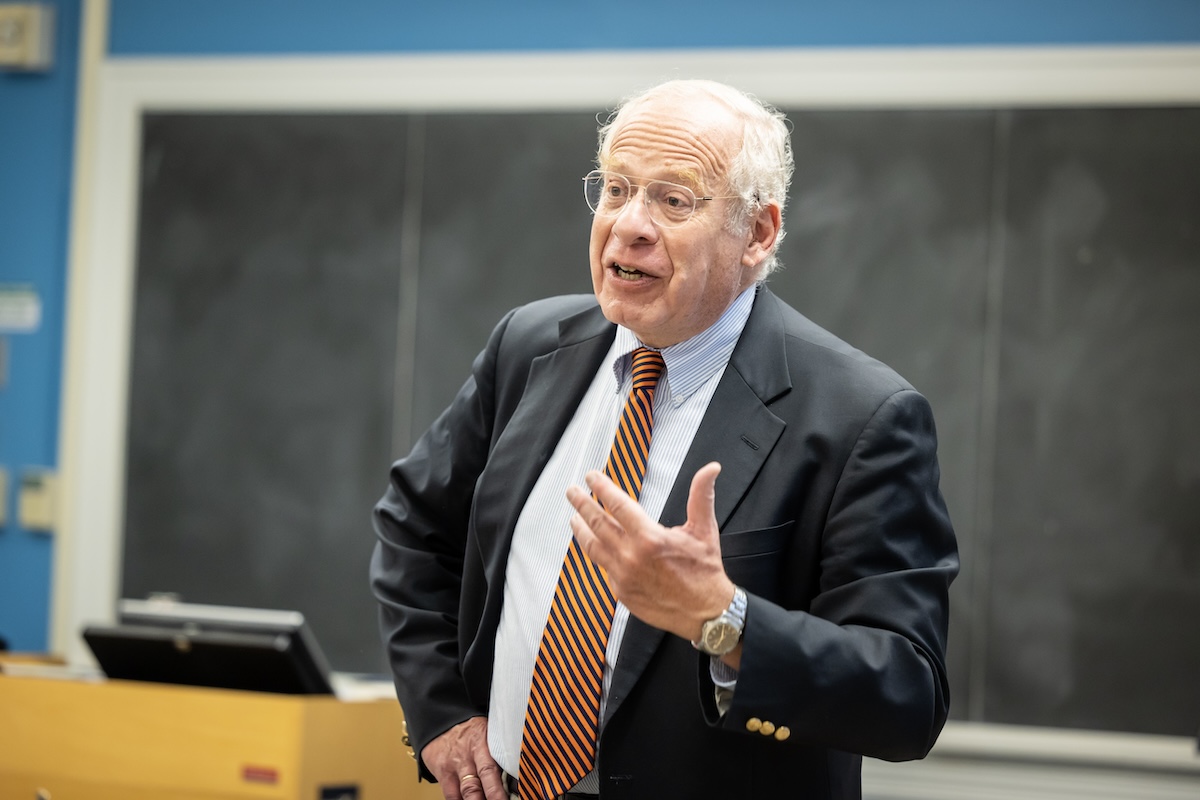
Historian Jonathan Rose has spent decades studying how ordinary people engage with literature and ideas. At Drew, he invites students to explore history not only through famous thinkers, but through the experiences of everyday readers.
Jonathan Rose’s research began with a simple question.
Who actually reads great books?
For generations, many scholars assumed that literature was written for and consumed primarily by elites. As a graduate student studying intellectual history, Rose initially accepted that assumption. But as he began exploring diaries, letters, and historical records, he discovered something surprising.
Ordinary readers were deeply engaged with the literature of their time.
Factory workers, chambermaids, soldiers, and shopkeepers were reading novels, discussing ideas, and forming their own interpretations of the books they encountered.
“I’m often more interested in how a Victorian chambermaid responded to a novel than in the novel itself,” Rose says.
That discovery reshaped his research and ultimately his career. For Rose, the story of literature is not only about the authors who write books. It is also about the readers who interpret them, challenge them, and sometimes transform their meaning entirely.
Rose joined the Drew faculty in 1984, drawn in part by the distinctive environment of a small liberal arts college.
“The small liberal arts college is a distinctively American institution,” he says. “It offers what big universities cannot — small classes, individualized instruction, and a devotion to the humanities.”
Those qualities remain central to his work in the classroom.
In Rose’s courses, students quickly learn that history is not simply a collection of established facts. It is an ongoing investigation built from questions, sources, and interpretation. They explore historical evidence, examine competing narratives, and consider how readers and thinkers across time have interpreted the ideas that shaped their worlds.
One of the most important moments in that process comes during Drew’s Senior Research Seminar, where students conduct original research projects and present their findings publicly at an event known as the “History Happening.”
For many students, it is the first time they see themselves not just as learners but as scholars.
Again and again, Rose has watched students uncover stories that reshape their understanding of the past.
“I never knew that in the 1930s nearly a million Mexican Americans were expelled from the United States,” he recalls learning from one student’s research project.
Moments like that remind him why teaching continues to be rewarding.
Students arrive curious. They leave with a deeper sense of intellectual confidence.
“They learn to ask better questions,” Rose says. “They learn that they can contribute something original.”
That sense of discovery is at the heart of the liberal arts experience.
At Drew, students are not simply absorbing knowledge created by others. They are learning how knowledge itself is constructed.
They examine sources, test interpretations, and develop their own arguments about the past. In the process, they discover that history is not static. It is shaped by inquiry, interpretation, and new perspectives.
Experiences like the Senior Research Seminar are also supported by philanthropy. Funds such as the Leavell-Oberg Fund provide grants that allow students to pursue ambitious research projects and explore historical questions in greater depth.
For Rose, opportunities like these are essential to the mission of a liberal arts education.
“Liberal arts education is worth supporting,” he says simply.
The impact of that support extends far beyond the classroom.
Students who conduct original research learn how to analyze complex evidence, challenge assumptions, and develop their own interpretations of the world around them.
In the process, they discover something important.
Their ideas matter.
And that realization often becomes one of the defining moments of their time at Drew.
Because history is not only about understanding the past.
It is about discovering that your own questions can shape the future.
Experiences like these are made possible through the support of alumni and donors who believe in the power of a Drew education. As the fiscal year comes to a close, your support helps ensure that future students continue to discover their curiosity, confidence, and purpose at Drew.