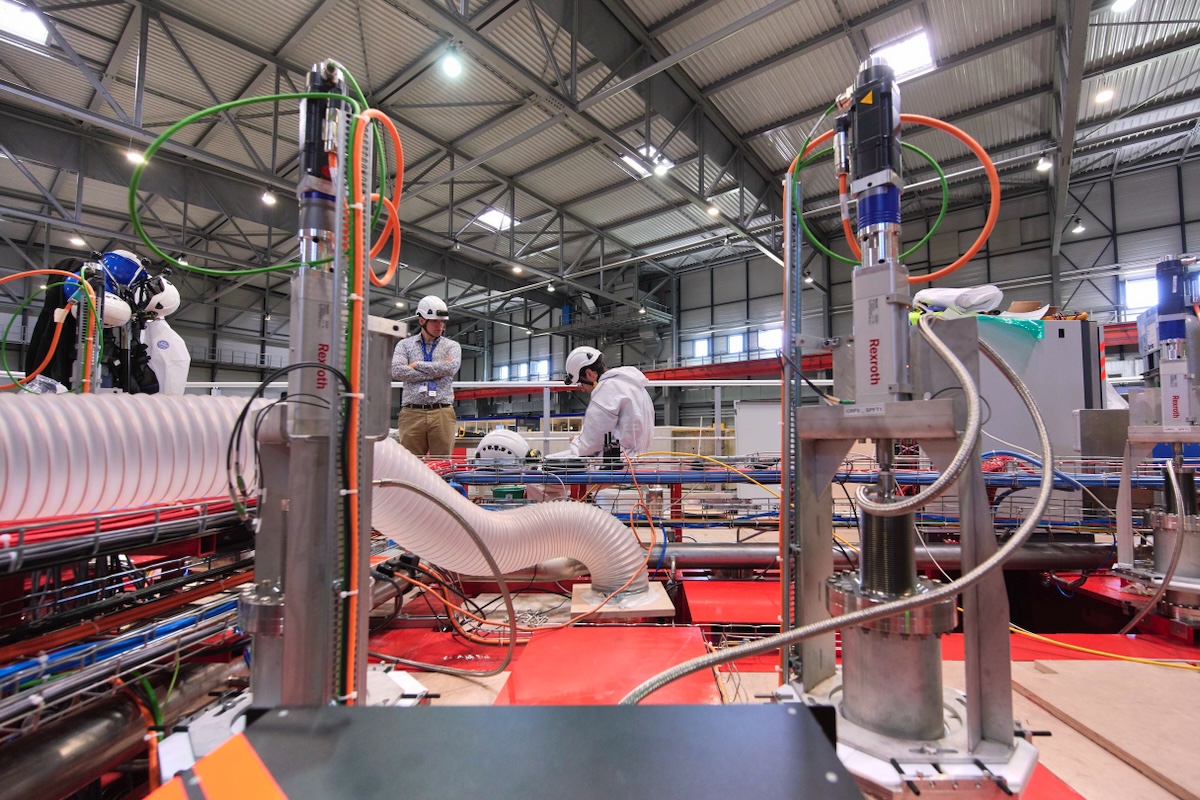
Largest particle physics lab in the world, site of the Large Hadron Collider
January 2026 – Drew University has strengthened its physics program through an international physics research partnership with the European Organization for Nuclear Research (CERN), one of the world’s leading scientific laboratories.
Enlarge
Courtesy: CERN
The partnership with CERN, which operates the largest particle physics lab in the world, will connect faculty and students with cutting-edge research in particle physics, engineering, computing, and technology.
“This partnership positions Drew as a contributor to global science and is a gateway for students to participate in international collaborations and interdisciplinary training,” said Kamal Benslama, assistant professor of physics, principal investigator of the Drew Particle Physics Group, and co-director of the master in data science with applications in high energy physics, who led Drew’s efforts in securing the CERN partnership.
Students will be able to take advantage of academic opportunities including research, hands-on training, lectures, and networking with scientists from around the world, and will get exposure to multidisciplinary, multicultural research environments that deepens classroom learning and prepares them for STEM careers.
Specifically, Drew students will be able to join the Drew Particle Physics Group to collaborate with faculty on CERN’s ProtoDUNE project. The project is a major prototype neutrino detector at CERN’s Neutrino Platform, built to develop and validate the technology for the Deep Underground Neutrino Experiment (DUNE), one of the next-generation flagship neutrino experiments in the world.
Students are also able to pursue competitive programs like CERN’s Summer Student Programme where they will be able to work on research projects with experimental teams and attend lectures on particle physics, data science, AI, machine learning, and computing.
The first Drew student to visit CERN will be Brendan Mullany C’25, G’26. As an undergraduate, Mullany completed an honors thesis on the Mu2e experiment at the U.S. Department of Energy’s Fermi National Accelerator Laboratory (Fermilab), of which Drew is an institutional member.
Mullany decided to stay at Drew, enrolling in the Caspersen School of Graduate Studies’ data science program, with application in particle physics. He will collaborate with Benslama and scientists at Argonne National Laboratory on the ProtoDUNE experiment.